A U.S. taxpayer may discover that foreign bank accounts or a foreign corporation were never reported on prior U.S. tax returns.
The IRS Streamlined Domestic Offshore Procedures offer a path back into compliance with a 5% offshore penalty, but only if the failures were non-willful.
Eligibility depends on Form 14654 and the taxpayer’s sworn explanation of the noncompliance.
The IRS evaluates that statement under the same standards courts use to determine willfulness, recklessness, and willful blindness.
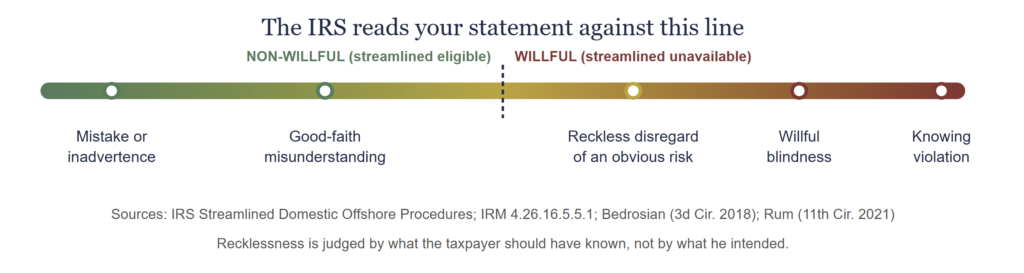
What “non-willful” means
The IRS defines the term narrowly: “Non-willful conduct is conduct that is due to negligence, inadvertence, or mistake or conduct that is the result of a good faith misunderstanding of the requirements of the law” (IRS, Streamlined Domestic Offshore Procedures). Everything outside that definition is willful.
Willfulness is broader than deliberate evasion. The Internal Revenue Manual treats a person as willful if he “(1) knowingly violated a legal duty; (2) recklessly violated a legal duty; or (3) acted with ‘willful blindness’ by making a conscious effort to avoid learning about a legal duty” (IRM 4.26.16.5.5.1).
Recklessness is judged objectively, and the Third Circuit held that a taxpayer is reckless when he “(1) clearly ought to have known that (2) there was a grave risk that [an accurate FBAR was not being filed] and if (3) he was in a position to find out for certain very easily” (Bedrosian v. United States, 912 F.3d 144 (3d Cir. 2018)).
The FBAR is the annual Treasury report of foreign accounts, and the Eleventh Circuit applies the same test to it (United States v. Rum, 995 F.3d 882 (11th Cir. 2021)).
What the statement must contain
Form 14654 directs the taxpayer to “Provide specific reasons for your failure to report all income, pay all tax, and submit all required information returns, including FBARs” (IRS Form 14654). It then adds: “Include the whole story including favorable and unfavorable facts.”
The form calls for the taxpayer’s “personal background, financial background, and anything else you believe is relevant.”
And the source of funds in every account, including “whether you inherited the account/asset, whether you opened it while residing in a foreign country, or whether you had a business reason to open or use it.”
Account activity must be described, and any adviser relied on must be identified by “name, address, and telephone number” with “a summary of the advice.”
A conclusory or incomplete narrative can be costly. Form 14654 states that a submission without a factual explanation is incomplete and ineligible for streamlined penalty relief. In that event, the returns may be processed without the favorable treatment available under the Streamlined Domestic Offshore Procedures.(IRS, Streamlined Domestic Offshore Procedures).
The facts the IRS weighs
The IRS and the courts do not accept a taxpayer’s label for his own conduct. They examine the surrounding record, and the same facts recur in the guidance and the reported cases.
| Points toward willfulness | Supports non-willfulness |
|---|---|
| Checking “No” on the Schedule B foreign-account question, called “a significant fact” for willful blindness and recklessness (IRM 4.26.16.5.5.1). | All income from the account was reported and the omission was an isolated oversight (IRM 4.26.16.5.5.1, example 1). |
| Signing returns without reading them while the foreign-account answer was wrong (Rum). | Full cooperation and complete production of account records once the issue surfaced (IRM 4.26.16.5.5.1, example 1). |
| Never telling the long-time accountant about the accounts, treated as “a conscious effort to avoid learning about reporting requirements” (United States v. Ott (E.D. Mich. 2020)). | Documented disclosure of the accounts and companies to the preparer, with records of the advice received. |
| A relative’s foreign address, nominees or layered entities that kept statements and ownership out of view (Ott). | Accounts inherited or opened while living abroad, with an ordinary purpose for each account and entity (Form 14654). |
| Earlier FBARs, warning letters or other prior notice followed by continued omissions (IRM 4.26.16.5.5.1). | A narrative that matches every amended return, information return and FBAR in the package. |
Reliance on an adviser is not a safe harbor. In Ott the taxpayer relied on advice received as a young adult, and the court found recklessness because he never verified it with the accountant who prepared his returns (United States v. Ott).
Foreign companies need their own explanation
The certification covers every required information return, and the IRS lists “Forms 3520, 3520-A, 5471, 5472, 8938, 926, and 8621” among the filings in a streamlined package (IRS, Streamlined Domestic Offshore Procedures). Form 5471, for example, reports ownership of a foreign corporation.
A statement that explains the accounts but not the company filings leaves part of the certification unsupported. Each entity should be described: when and why it was formed, who controlled it, what it owned, and what the taxpayer understood about its U.S. reporting.
Risk of an Inadequate Certification
The certification is signed under penalties of perjury. The form warns that if the IRS “receives or discovers evidence of willfulness, fraud, or criminal conduct, it may open an examination or investigation that could lead to civil fraud penalties, FBAR penalties, information return penalties, or even referral to Criminal Investigation” (IRS Form 14654).
Streamlined returns “may be selected for audit” and checked “against information received from banks, financial advisors, and other sources” (IRS, Streamlined Filing Compliance Procedures).
A non-willful FBAR failure is “a single reporting violation,” while a willful one “can result in multiple penalties depending on the number of accounts” (IRM 4.26.16.1.7).
Taxpayers whose facts point toward willfulness are directed to “consider participating in the IRS Criminal Investigation Voluntary Disclosure Practice” (IRS, Streamlined Filing Compliance Procedures). That choice comes first, before anything is filed.
How Dilendorf Law Firm helps
Dilendorf Law Firm guides U.S. taxpayers through the IRS Streamlined Domestic and Foreign Offshore Procedures and represents them before the IRS from the first privileged consultation through acceptance of the submission.
We review the facts before recommending a disclosure path. We analyze each foreign account and entity. We review the Schedule B answers on prior returns, what was disclosed to tax preparers, the source of funds, and any prior notice of the reporting obligation.
If the facts support non-willfulness, we prepare the certification using contemporaneous records, not recollections. We address each account and entity separately. We present both favorable and unfavorable facts. We also ensure the narrative is consistent with every amended return, information return, and FBAR in the submission.
If the facts point the other way, we advise on the Voluntary Disclosure Practice before a sworn certification is signed.
To discuss an unreported foreign account or company, call +1 212 457 9797 or email info@dilendorf.com.
Frequently asked questions
What does the IRS mean by non-willful?
Conduct “due to negligence, inadvertence, or mistake” or “a good faith misunderstanding of the requirements of the law” (IRS). Reckless disregard and deliberate avoidance of the rules both count as willful.
I did not know about the FBAR. Is that enough?
Not by itself. Courts ask whether you clearly ought to have known and could easily have found out, and the foreign-account question on Schedule B is treated as notice (Bedrosian; IRM 4.26.16.5.5.1).
Can I leave out facts that hurt me?
No. Form 14654 requires “the whole story including favorable and unfavorable facts,” and the certification is signed under penalties of perjury (Form 14654). Omissions discovered later can cost the streamlined terms and more.
My accountant never asked about foreign accounts. Does that help?
Only if you disclosed the accounts and the preparer still failed to file. Withholding the accounts from a long-time accountant has been treated as evidence of recklessness (Ott).
Do I need to explain my foreign company as well as my accounts?
Yes. The certification covers all required information returns, including Form 5471 for foreign corporations, so the statement should explain each entity filing separately (IRS).
What is the penalty under the domestic streamlined program?
A 5 percent miscellaneous offshore penalty on the highest aggregate year-end balance of the unreported foreign financial assets during the covered years, plus tax and interest on the amended returns (IRS).
Will my streamlined submission be audited?
Not automatically, but it may be selected under normal audit procedures and checked against bank and adviser information (IRS). The statement should be written on the assumption that it will be examined.
What if my conduct might have been willful?
The IRS directs those taxpayers to consider the Criminal Investigation Voluntary Disclosure Practice instead (IRS). That choice should be made with counsel before anything is signed.
This article is for informational purposes only and does not constitute legal advice. Reading it does not create an attorney-client relationship with Dilendorf Law Firm. Attorney Advertising.
Sources
[1] IRS, U.S. Taxpayers Residing in the United States (Streamlined Domestic Offshore Procedures). https://www.irs.gov/individuals/international-taxpayers/u-s-taxpayers-residing-in-the-united-states
[2] IRS, Streamlined Filing Compliance Procedures. https://www.irs.gov/individuals/international-taxpayers/streamlined-filing-compliance-procedures
[3] IRS Form 14654, Certification by U.S. Person Residing in the United States for Streamlined Domestic Offshore Procedures (Rev. 9-2017). https://www.irs.gov/pub/irs-pdf/f14654.pdf
[4] Internal Revenue Manual 4.26.16, Report of Foreign Bank and Financial Accounts (FBAR), §§ 4.26.16.1.7 and 4.26.16.5.5.1. https://www.irs.gov/irm/part4/irm_04-026-016
[5] Bedrosian v. United States, Department of the Treasury, IRS, 912 F.3d 144 (3d Cir. 2018). https://www2.ca3.uscourts.gov/opinarch/173525p.pdf
[6] United States v. Rum, 995 F.3d 882 (11th Cir. 2021). https://media.ca11.uscourts.gov/opinions/pub/files/201914464.pdf
[7] United States v. Ott, 441 F. Supp. 3d 521 (E.D. Mich. 2020). https://www.govinfo.gov/content/pkg/USCOURTS-mied-2_18-cv-12174/pdf/USCOURTS-mied-2_18-cv-12174-1.pdf