
After a cryptocurrency theft, victims are often told the same thing:
A tracing report is needed.
A few weeks later they were sent a PDF document which looked professional and showed where the stolen cryptocurrency had ended up.
The victim now knows exactly where the money has gone, but the money is still missing.
A mistake that we frequently come across is the idea that crypto tracing and cryptocurrency recovery are identical. Yet they aren’t.
The tracing process shows how stolen assets move around the blockchain, and for them to be recovered, legal authority is needed so that the assets can be seized and then given back to the victims.
When we have been dealing with people who have been victims of crypto theft, many of them spend a good deal of time and money getting trace reports even though they never first consider some of the important questions mentioned below.
Who actually has the power to get the money back?
The response is a surprise to a great many victims.
A private forensic company is able to trace blockchain transactions but it cannot send out subpoenas since it doesn’t have the authority to do so.
It is impossible to obtain seizure warrants, it cannot require a cryptoexchange to do anything, and it also can’t start federal forfeiture proceedings.
The authority is given to law enforcement agencies and prosecutors through 18 USC § 981 (civil forfeiture).
This distinction is critical.
It might be possible to discover where the stolen assets ended up. Yet merely tracing them does not result in a legal duty on an exchange or stablecoin issuer to freeze the funds (or return them to the victim).
That is to say, a tracing report usually marks the start of a recovery strategy but is not the strategy itself.
The 2025 Internet Crime Report by the FBI states that the Internet Crime Complaint Center (IC3) received 181,565 complaints concerning cryptocurrency, the amount of losses being over $11.3 billion. (FBI IC3, 2025 Internet Crime Report, p. 52)
Since crypto-related crime is still increasing, it is important for victims to know what is possible through tracing and why legal authority under 18 U.S.C. § 981 is usually more important than blockchain analytics alone.
How Dilendorf Law Firm helps
Max Dilendorf has practiced as a digital asset lawyer since 2017 and has handled more than 100 cybercrime arbitrations and investigations.
When the funds are offshore, the firm collaborates with former law enforcement officers in order to draw the attention of U.S. law enforcement so that section 981 remedies may be invoked. The firm also assists clients through the recovery process.
If a U.S. exchange or stablecoin issuer is holding your funds, the firm will assist you in considering your legal options, such as filing a TRO, a complaint and/or applying for injunctive relief.
If your cryptocurrency has been stolen, contact Dilendorf Law Firm at +1 212 457 9797 or info@dilendorf.com.
What a tracing report can and can’t do
An analyst is able to track stolen coins through swaps and mixers until they get to a custodial exchange using public ledgers. Yet that marks only the start of the recovery, not its end.
The FBI was blunt when it stated that: “Private sector recovery companies cannot issue seizure orders to recover cryptocurrency.” (FBI PSA, Aug. 11, 2023).
Furthermore, FBI said that “Cryptocurrency exchanges only freeze accounts based on internal processes or in response to legal process.” Id.
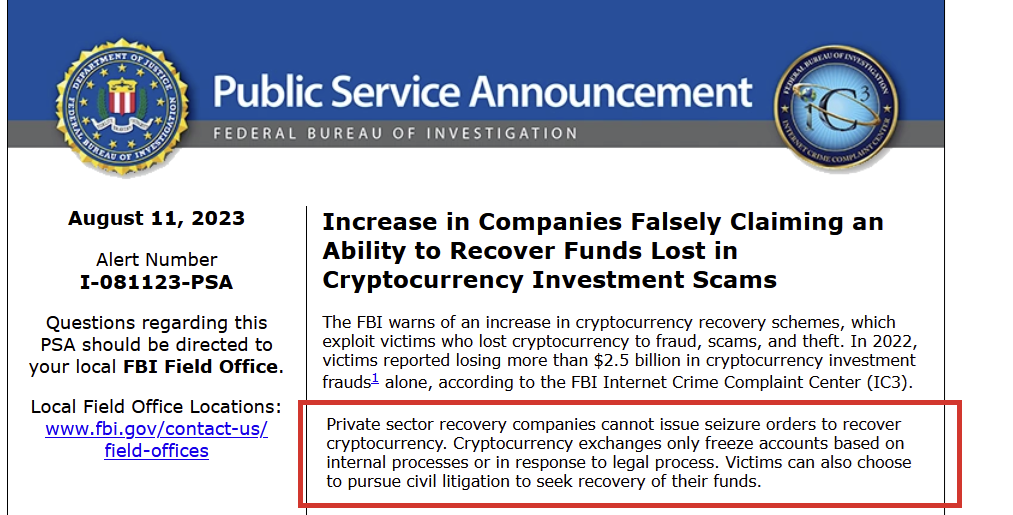
The same alert describes the failure mode: “Recovery scheme fraudsters charge an up-front fee and either cease communication with the victim after receiving an initial deposit or produce an incomplete or inaccurate tracing report and request additional fees to recover funds” (FBI PSA, Aug. 11, 2023).
A genuine forensic vendor is not a scammer, but it must be understood that a tracing report is not a recovery tool.
If there is no seizure warrant or court order, the report will not result in any exchange or financial institution having a legal obligation to take any action.
Who can actually seize stolen crypto
The Federal Civil Forfeiture statute set out in 18 USC § 981 states that “Any property, real or personal, which is derived from or consists of proceeds traceable to” wire fraud (for example, Sections 1029, 1030, 1032, or 1344) and other “specified unlawful activity” (18 U.S.C. § 981(a)(1)(C)).
“Any property subject to forfeiture to the United States under subsection (a) may be seized by the Attorney General…”(18 U.S.C. § 981(b)(1)).
Moreover, “Seizures pursuant to this section shall be made pursuant to a warrant obtained in the same manner as provided for a search warrant under the Federal Rules of Criminal Procedure…” (18 U.S.C. § 981(b)(2)). [emphasis added].
The statute also covers “The property was lawfully seized by a State or local law enforcement agency and transferred to a Federal agency.” (18 U.S.C. § 981(b)(2)(C)).
That is the only approach available to a district attorney’s cybercrime unit, not one that is operated by a private tracing firm lacking the power to issue subpoenas or seizure warrants.
It should be noted that the term ‘private party’ is not mentioned anywhere in the text of 18 USC § 981 (‘Civil Forfeiture’).
What a real recovery looks like
Recent cases handled by the Secret Service illustrate how crypto seizure cases function.
In one instance, the agents confiscated the funds that had been obtained through investment fraud from an account at a foreign bank.
The U.S. Attorney filed a civil forfeiture complaint, and a settlement provided that “$7 million of the seized funds would be forfeited to the United States, allowing victims to petition to recover on their losses” (U.S. Attorney’s Office, E.D. Va., Mar. 21, 2025).
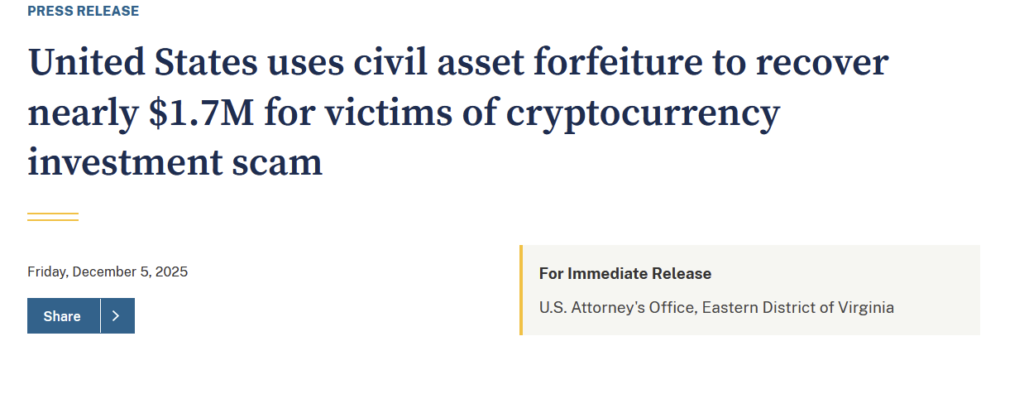
In December 2025 the same office recovered stablecoins that Secret Service agents had seized “from three cryptocurrency wallets” (U.S. Attorney’s Office, E.D. Va., Dec. 5, 2025).
On July 21, 2026, the U.S. Attorney for the District of Columbia filed five civil forfeiture complaints covering more than $25 million in cryptocurrency seized by Secret Service agents (U.S. Attorney’s Office, D.C., July 21, 2026).
Each case started with tracing, but these cases stand for the principal that to successully recover the funds you need a federal agencies with § 981 power.
How victims are paid
The money that has been forfeited is returned to the victims by means of remission or restoration.
In order to be considered a victim, one must demonstrate “a financial loss amounting to a specific figure…and that the loss is supported by documentary evidence such as invoices and receipts.” (28 C.F.R. § 9.8(b)(1)).
Moreover, the monetary loss endured by a victim… is to be restricted to the fair market value of the property from which the victim was deprived as of the date on which the loss occurred. No account shall be made for the interest lost or for any incidental expenses incurred in recovering the lost property or in seeking other compensation.” (28 C.F.R. § 9.8(c)). [emphasis added].
Where a private law firm fits
The FBI notes that “Victims can also choose to pursue civil litigation to seek recovery of their funds” (FBI PSA, Aug. 11, 2023).
That path works usually works when a counterparty is located inside U.S. jurisdiction: an exchange, stablecoin issuer, bank, or domestic account holder.
Depending on the facts, counsel could file a temporary restraining order (TRO) over identified assets, file a complaint, and pursue injunctive relief.
When the funds are located at an offshore exchange with no U.S. presence, only an agency with seizure authority under § 981 can act.
What to do this week
- The most important information you can give is details of the transaction. This includes the cryptocurrency address, the amount and type of cryptocurrency, the date and time, and the transaction ID (hash) (FBI, Guidance for Cryptocurrency Scam Victims, Aug. 24, 2023).
- Make sure to write to each exchange and ask them to keep the records and to hold the funds until a legal procedure has been carried out. “Cryptocurrency exchanges only freeze accounts based on their internal procedures or as a result of a legal process” (FBI PSA, Aug. 11, 2023). Requesting that the funds be frozen could give you additional time.
- Check the forensic engagement to verify that the forensic vendor will provide exhibits suitable for use in an affidavit, will file freeze requests, and will assist with an agency referral. Make sure that all of these points are included in your engagement letter to the forensic firm.
- Look at the corresponding counterparts in the United States. Any domestic exchange, issuer, or bank which holds your money could be a suitable target for a TRO or a civil suit.
- It is important to keep all your receipts since remission requires documentary proof of “a pecuniary loss of a specific amount…and that the loss is supported by documentary evidence including invoices and receipts.” (28 C.F.R. § 9.8(b)(1)).
- Be careful about anyone offering to recover your money since they might be engaging in another scam (FBI, August 24, 2023).
Frequently asked questions
Can a blockchain forensic firm get my stolen crypto back?
Not by itself. A forensic company will be able to track the funds and find out at which exchange your funds have been deposited (which is important evidence). However, the FBI says that “Private sector recovery companies are not allowed to issue seizure orders in order to recover cryptocurrency.” Moreover, exchanges only freeze accounts “through their internal procedures or in response to a legal request” (FBI PSA, Aug. 11, 2023). A recovery process requires a court order or a seizure warrant, something that a forensic report cannot take the place of.
Who has the authority to seize stolen cryptocurrency?
According to the federal civil forfeiture law, property which can be traced to wire fraud “may be seized by the Attorney General”; seizures “must be carried out on the basis of a warrant obtained in the manner provided for a search warrant under the Federal Rules of Criminal Procedure” (18 U.S.C. § 981(b)(1)–(2)).In reality, federal agents (typically the FBI or the U.S. Secret Service) act in conjunction with an Assistant United States Attorney; furthermore, state and local agencies are also able to seize property and hand it over to a federal agency (18 U.S.C. § 981(b)(2)(C)); private firms and law firms, on the other hand, do not have the power to carry out seizures.
What is 18 U.S.C. § 981 and why does it matter to victims?
It is the federal civil forfeiture statute. It makes “any property, real or personal, which constitutes or is derived from proceeds traceable to” wire fraud and other specified unlawful activity forfeitable to the United States (18 U.S.C. § 981(a)(1)(C)).
It matters because it is mechanism by which stolen crypto held at an exchange or in a wallet is frozen/seized and then returned to victims (typically through remission or restoration program). Without an agency willing to use tracing firm’s forensic report, tracing doesn’t really have an endpoint.
Will an exchange freeze the thief’s account if I ask?
Sometimes briefly, but you should not count on it. The FBI explains that “Cryptocurrency exchanges only freeze accounts based on internal processes or in response to legal process” (FBI PSA, Aug. 11, 2023).
Prompt written notice with transaction hashes could trigger internal compliance review; that’s why it is worth sending it. However, a proper freeze usually requires a subpoena/seizure warrant, or court order. This is where U.S. law enforcement comes in.
How do victims actually receive forfeited cryptocurrency?
Through the Department of Justice remission process or through restoration to satisfy a restitution order. After seizure, the U.S. Attorney’s Office “identifies all potential victims and notifies them of the opportunity to file a petition for remission” (DOJ, Returning Forfeited Assets to Crime Victims). The victim must document “a pecuniary loss of a specific amount” with “invoices and receipts,” and when funds are insufficient they are generally distributed “on a pro rata basis” (28 C.F.R. § 9.8(b), (f)).
Can I recover the fees I paid a tracing company?
Not through remission. The regulation limits recovery to the fair market value of the property on the date of loss and states that “no allowance shall be made for interest forgone or for collateral expenses incurred to recover lost property or to seek other recompense” (28 C.F.R. § 9.8(c)). Forensic fees, legal fees, and investigative costs fall within that exclusion. This is a practical reason to tie any forensic engagement to concrete referral and recovery work rather than paying for a standalone report.
When can a private law firm help, and when is it only law enforcement?
The FBI notes that “Victims can also choose to pursue civil litigation to seek recovery of their funds” (FBI PSA, Aug. 11, 2023).
Depending on the facts/circumstances, a firm like Dilendorf Law Firm could file a TRO, a complaint, or pursue injunctive relief against U.S. counterparties (e.g., crypto exchange or stablecoin issuer).
Where funds are located at an offshore exchange, only an agency with seizure and forfeiture authority, such as the FBI or Secret Service, or a prosecutor’s office can reach them; counsel’s job then is to build a referral those agencies can adopt.
How do I tell a legitimate crypto recovery lawyer from a scam?
FBI issued the list of red flags to watch out for. Be cautious of firms that contact you unexpectedly, and “Request video verification or documentation…” (FBI PSA, Aug. 13, 2025).
Claims of official government partnership are false: “There are no law firms which are officially authorized partners of US Government agencies” (FBI PSA, Aug. 13, 2025). Requests for payment in cryptocurrency or gift cards (or promises of guaranteed recovery) are clear warning signs.
This article is for general informational purposes only and does not constitute legal advice. Reading it does not create an attorney-client relationship with Dilendorf Law Firm. Attorney Advertising.
Sources
[1] Federal Bureau of Investigation, Internet Crime Complaint Center, “2025 Internet Crime Report,” April 2026, p. 52. https://www.ic3.gov/AnnualReport/Reports/2025_IC3Report.pdf
[2] Federal Bureau of Investigation, Public Service Announcement I-081123-PSA, “Increase in Companies Falsely Claiming an Ability to Recover Funds Lost in Cryptocurrency Investment Scams,” August 11, 2023. https://www.ic3.gov/PSA/2023/psa230811
[3] Federal Bureau of Investigation, Public Service Announcement, “Fictitious Law Firms Targeting Cryptocurrency Scam Victims Offering to Recover Funds” (update), August 13, 2025. https://www.ic3.gov/PSA/2025/PSA250813
[4] Federal Bureau of Investigation, Public Service Announcement, “FBI Guidance for Cryptocurrency Scam Victims,” August 24, 2023. https://www.ic3.gov/PSA/2023/psa230824
[5] 18 U.S.C. § 981, Civil forfeiture (U.S. Code 2023 edition, Office of the Law Revision Counsel via GovInfo). https://www.govinfo.gov/content/pkg/USCODE-2023-title18/html/USCODE-2023-title18-partI-chap46-sec981.htm
[6] 28 C.F.R. § 9.8, Remission procedures for victims (Electronic Code of Federal Regulations, current as of September 15, 2026). https://www.ecfr.gov/current/title-28/chapter-I/part-9/section-9.8
[7] U.S. Department of Justice, Criminal Division, “Returning Forfeited Assets to Crime Victims: An Overview of Remission and Restoration.” https://www.justice.gov/file/440746/dl
[8] U.S. Attorney’s Office, Eastern District of Virginia, “United States uses civil asset forfeiture to recover $7M of investment fraud proceeds,” March 21, 2025. https://www.justice.gov/usao-edva/pr/united-states-uses-civil-asset-forfeiture-recover-7m-investment-fraud-proceeds
[9] U.S. Attorney’s Office, Eastern District of Virginia, “United States uses civil asset forfeiture to recover nearly $1.7M for victims of cryptocurrency investment scam,” December 5, 2025. https://www.justice.gov/usao-edva/pr/united-states-uses-civil-asset-forfeiture-recover-nearly-17m-victims-cryptocurrency
[10] U.S. Attorney’s Office, District of Columbia, “Investigations into Cryptocurrency Scams Result in Seizure of More Than $25 Million,” July 21, 2026. https://www.justice.gov/usao-dc/pr/investigations-cryptocurrency-scams-result-seizure-more-25-million