
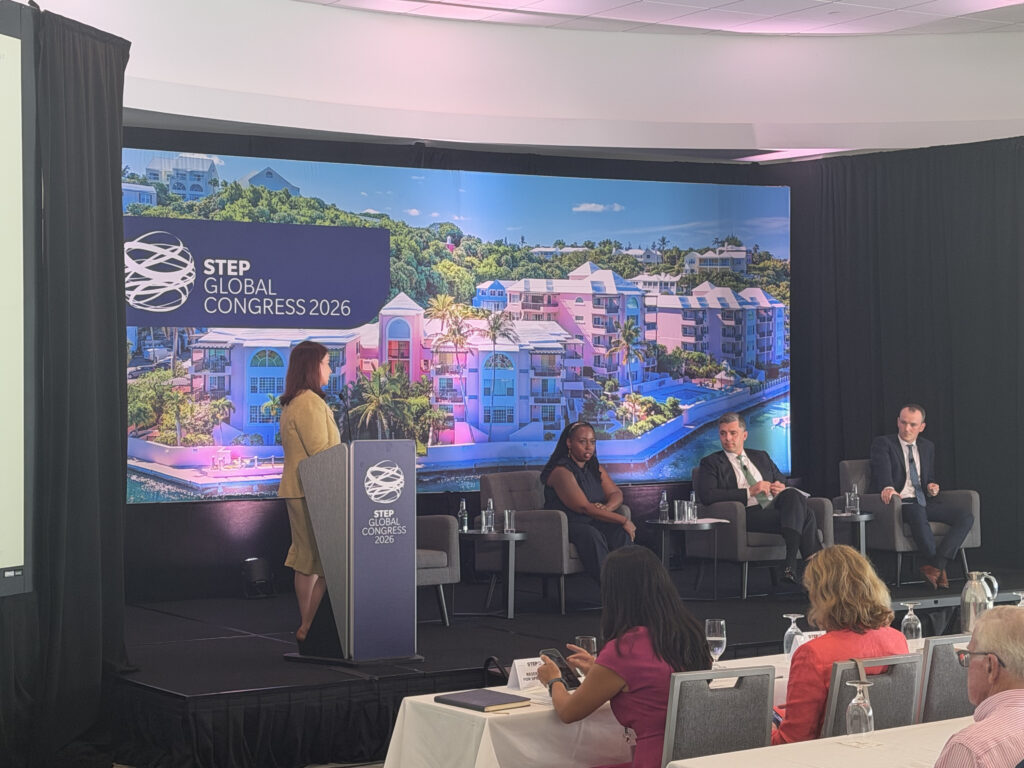
I just returned from the STEP Global Congress in Bermuda, a two-day meeting of trust and estate professionals [1]. I presented there on “Fiduciary Duties and Taxation in the Digital Age: What is Behind the Digital Assets?” One trend came up again and again: more Americans are setting up an offshore trust. Far fewer ask a simple question before they sign. If something goes wrong, who decides the dispute, where, and at what cost?
Key takeaways
- In the most popular offshore jurisdictions, the trust statute sends disputes to a local court. Final appeals go to the Privy Council, a court in London.
- Arbitration, meaning a private decision-maker instead of a court, is only starting to reach offshore trusts.
- In several jurisdictions, a judge can order a plaintiff who lives abroad to deposit money before the case moves ahead.
Where Americans are setting up offshore trusts
The jurisdictions I heard named most at the Congress were familiar: Bermuda, the Cayman Islands, the British Virgin Islands (BVI), Jersey, Nevis and the Cook Islands.
The Bahamas and Guernsey are also common choices. We have written about these structures in Rethinking Offshore Asset Protection and about Cook Islands trust risks.
A key topic at the Congress was what happens after signing: trust administration, and disputes among the people at the center of every trust. The settlor creates and funds the trust.
The trustee holds and manages the assets. The protector watches the trustee and approves certain decisions. The beneficiaries are the people the trust is for. Add the financial advisor who invests the assets, and a dispute can start in many places.
2017–2026One protector dispute, from the trustees’ proposal to the final ruling in London [2]
EC$270,000Bond a creditor deposits before suing Nevis trust property, about US$100,000 [3]
39–0Guernsey’s May 2026 vote to have a trust arbitration law prepared [4]
35%IRS penalty rate that can apply to unreported transfers to a foreign trust [5]
An offshore trust dispute usually goes to a local court
In my experience, the dispute clause is one of the most overlooked provisions in a trust document. When the document is silent, the trust statute fills the gap, and each statute points to a local court.
| Jurisdiction | Court named in the trust statute | What the official record shows |
|---|---|---|
| Bermuda | Supreme Court of Bermuda [6] | A judge may order a plaintiff who lives abroad to deposit security for costs [7] |
| Cayman Islands | Grand Court [8] | Cayman “will continue to rely on the Grand Court to resolve trust disputes” [9] |
| BVI | High Court [10] | A trustee may submit a claim to arbitration [10] |
| Jersey | Royal Court [11] | Reviewed trust arbitration in 2025; no change proposed [12] |
| Nevis | High Court [3] | Creditors deposit a bond before suing trust property [3] |
| Cook Islands | High Court of the Cook Islands [13] | In 2025–26, the Privy Council received its first Cook Islands and Niue filing since 2019 [14] |
All six send final appeals to the Privy Council in London [15]. Statutes as published on official sites in November 2026.
That means local lawyers, local procedure and travel. From New York or Miami, some of these courts can take as much as 20 hours to reach. A final appeal is heard in London. The Privy Council now offers online hearings routinely, “so that it is no longer necessary for lawyers overseas to travel to London,” and it reports “a significant increase in filings related to business, property, wills, and trusts” [14]. The earlier rounds still happen locally.
One protector dispute, 2017 to 2026
In March 2026, the Privy Council decided an appeal from Bermuda about family trusts.
In 2017, the trustees proposed dividing the trust property between two branches of the family. The trust documents required the protectors’ consent but did not say how far that power went.
Two Bermuda courts held that the protectors could only check that the plan was lawful. The Privy Council disagreed: the protectors could use their own judgment and refuse [2].
What the trust document leaves unsaid, a court will decide, and that takes time.
Trust arbitration offshore is only starting
In parts of the United States, trust arbitration is an accepted option. Florida’s statute says a trust provision requiring arbitration of disputes between beneficiaries and a trustee, other than disputes over validity, “is enforceable” [16].
The American Arbitration Association publishes arbitration rules written for wills and trusts [17]. Offshore, the picture is mixed.
- The Bahamas: since 2011, an arbitration clause in a trust document has effect “as if it were an arbitration agreement” [18].
- Guernsey: in May 2026, its parliament voted 39–0 to have a law prepared for arbitrating disputes “between trustees, beneficiaries and/or other power holders” [19] [4].
- Jersey: a July 2025 government paper found most respondents “unaware of any demand for arbitration” and proposed no change [12].
- Cayman Islands: its Law Reform Commission wrote that trust arbitration “would be fulfilling a need which simply does not exist” [20].
My own view, and it is only a view: trust cases are important work for a small jurisdiction’s courts and lawyers, and I do not expect them to give it up quickly. The official papers give other reasons, such as experienced local judges and the difficulty of binding children to a private process [20] [12].
What a dispute can cost before it starts
Some costs arrive before anyone hears your side.
In Bermuda and Cayman, a judge can order a plaintiff who lives abroad to deposit security for costs: money set aside to cover the other side’s legal fees if the plaintiff loses [7] [21]. In Jersey, “any plaintiff may be ordered to give security for costs” [22]. In Nevis, a creditor must deposit a bond of EC$270,000, about US$100,000, before suing trust property [3] [23]. The Cayman commission noted that Grand Court trust litigation “may involve significant court fees” [20].
Then add U.S. tax. A trust is foreign for U.S. tax purposes unless a U.S. court can supervise it and U.S. persons control its major decisions. Missed reporting can cost the greater of $10,000 or 35% of the amount transferred [5].
Questions to answer before you sign
Where and how
- Which court or arbitration body decides a dispute?
- Will local law enforce an arbitration clause against every beneficiary?
- Can hearings be held online?
- Where does an appeal go?
Cost and the worst case
- Must I deposit money before filing?
- Who pays the trustee’s legal fees during a dispute?
- What happens if I die or lose capacity?
- Who can remove the trustee, protector or financial advisor, and how?
Settle these answers before signing, while everyone still agrees.
How Dilendorf Law Firm helps
We advise Americans who are setting up or reviewing an offshore trust in Bermuda, Cayman, the BVI, Jersey, Nevis, the Cook Islands and other jurisdictions. Our international tax lawyers handle the U.S. reporting side. Our arbitration lawyers review dispute clauses, working alongside counsel in the chosen jurisdiction. To schedule a case evaluation, contact us. Consultations are paid.
Related reading: Offshore banking risks for Americans · Your offshore trust is on a stolen list · AI cyberattacks and asset protection trusts · Who pays arbitration fees
Frequently asked questions
Can I require arbitration in my offshore trust?
It depends on the jurisdiction. The Bahamas has a statute for it, and Guernsey is preparing one. Elsewhere, ask local counsel in writing whether a clause would bind every beneficiary.
Can I sue an offshore trustee in a U.S. court?
Sometimes. But a win elsewhere may not help. Jersey’s trust law says a foreign court judgment or arbitration decision will not be enforced to the extent it conflicts with Jersey’s rules on a trust’s validity and administration [11].
Sources
[1] STEP Global Congress 2026, Hamilton, Bermuda, November 24–25, 2026 (event page). https://www.stepevents.org/event/GlobalCongress/summary
[2] Judicial Committee of the Privy Council, A and 6 others v C and 13 others (Bermuda) [2026] UKPC 11, press summary, March 19, 2026. https://caselaw.nationalarchives.gov.uk/ukpc/2026/11/press-summary
[3] Nevis International Exempt Trust Ordinance, Cap. 7.03 (N), Law Commission of St. Christopher and Nevis. https://lawcommission.gov.kn/wp-content/documents/Ord17TOC/Ch-07_03N-Nevis-International-Exempt-Trust-Ord.pdf
[4] States of Guernsey, Resolution of May 20, 2026, on arbitration of trust disputes. https://parliament.gg/parliamentary-business/assets/resolutions/resolution-vii-2026-2026-05-20
[5] Internal Revenue Service, Instructions for Form 3520. https://www.irs.gov/instructions/i3520
[6] Bermuda, Trustee Act 1975 (consolidated). https://www.bermudalaws.bm/Laws/Consolidated%20Law/1975/Trustee%20Act%201975
[7] Bermuda, Rules of the Supreme Court 1985, Order 23. https://www.bermudalaws.bm/Laws/Consolidated%20Law/1985/Rules%20of%20the%20Supreme%20Court%201985
[8] Cayman Islands, Trusts Act (2021 Revision). https://legislation.gov.ky/cms/images/LEGISLATION/PRINCIPAL/1967/1967-0006/1967-0006_2021%20Revision.pdf
[9] Cayman Islands Law Reform Commission, Trusts Law Reform project page. https://www.gov.ky/web/lrc/trusts-law-reform
[10] Virgin Islands, Trustee Act, Revised Edition as at January 1, 2020. https://laws.gov.vg/sites/default/files/2024-07/Trustee%20Act.pdf
[11] Trusts (Jersey) Law 1984, Articles 1 and 9. https://www.jerseylaw.je/laws/current/l_11_1984
[12] Government of Jersey, Department for the Economy, Trusts Law Consultation Response Paper, July 2025. https://www.gov.je/md/MDAttachments/External%20Relations/Supporting%20Documents%202025/MD-ER-2025-563%202025.07.30%20Response%20Paper%20(final).pdf
[13] Cook Islands, International Trusts Act 1984, Financial Supervisory Commission. https://www.fsc.gov.ck/Documentation/FC/International%20Trusts%20Act%201984.pdf
[14] The Supreme Court and Judicial Committee of the Privy Council, Annual Report 2025–2026. https://jcpc.uk/uploads/UKSC_The_Supreme_Court_AR_As_2025_26_v11_9604c67c65.pdf
[15] Judicial Committee of the Privy Council, Practice Directions (jurisdictions). https://jcpc.uk/appeal-process/practice-directions
[16] Florida Statutes § 731.401, Arbitration of disputes. https://www.flsenate.gov/Laws/Statutes/2023/0731.401
[17] American Arbitration Association, Wills and Trusts Arbitration Rules and Mediation Procedures. https://www.adr.org/media/cf4duv4f/commercial-wills-and-trusts-rules-oct-21-2011.pdf
[18] The Bahamas, Trustee Act, section 91A. https://laws.bahamas.gov.bs/cms/images/LEGISLATION/PRINCIPAL/1998/1998-0022/1998-0022.pdf
[19] States of Guernsey, Committee for Economic Development, Policy Letter P.2026/21, March 20, 2026. https://parliament.gg/parliamentary-business/assets/propositions/P2026-21
[20] Cayman Islands Law Reform Commission, Trusts Law Reform Discussion Paper, April 5, 2017. https://gov.ky/documents/35692/0/Discussion+Paper+-+Trusts+Law+Reform+-+5+April+2017.pdf/13857500-fcf0-4174-c352-7ac4fd1c3416?t=1766163116459
[21] Cayman Islands, Grand Court Rules (2023 Revision), Order 23. https://legislation.gov.ky/cms/images/LEGISLATION/SUBORDINATE/2003/2003-0002/2003-0002_2023%20Revision.pdf
[22] Jersey, Royal Court Rules 2004. https://www.jerseylaw.je/laws/current/ro_161_2004
[23] Eastern Caribbean Central Bank, Currency (EC$2.70 to US$1.00). https://www.eccb-centralbank.org/currency
This article is for general informational purposes only and does not constitute legal advice. Reading it does not create an attorney-client relationship with Dilendorf Law Firm. Attorney Advertising. Prior results do not guarantee a similar outcome.