
Many Americans own a home or land in another country. Some bought it years ago. Some inherited it. Some received it as a gift from family abroad.
Sooner or later it is sold, and a simple question arises: what do I tell the IRS? The answer depends on where the property is, how you came to own it, what the local country charged, and how the money came home.
Who this applies to
- U.S. citizens and green-card holders, including dual citizens, selling property abroad
- People who inherited or were given a home or land in another country
- Anyone who opened an overseas bank account to receive the proceeds
The United States taxes citizens and residents on worldwide income [1].
The IRS taxes the sale, wherever the property is located
A house in Tuscany, a condo in Punta Cana, or a cottage in Ontario: to the IRS it makes no difference.
“If you are a U.S. citizen with income from dispositions of property outside the United States (foreign income), you must report all such income on your tax return unless it is exempt from U.S. law.”
IRS Publication 544 [1]
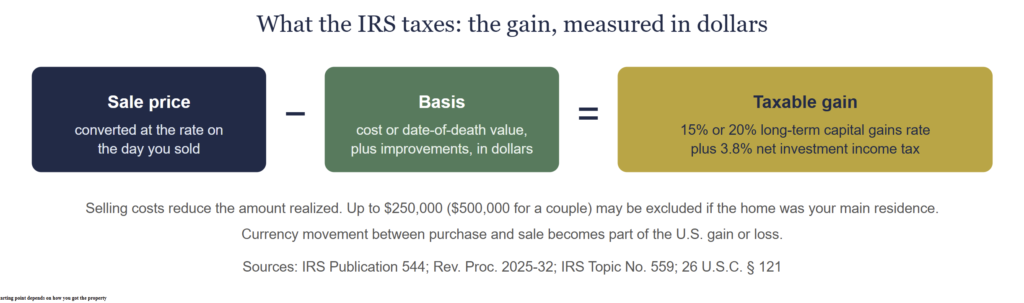
What is taxed is the profit, not the price: the sale price minus your “basis,” which is roughly what the property cost you plus permanent improvements, less selling costs [1].
Owned more than a year, the profit is a long-term capital gain. For 2026 the rate is 15 percent for most sellers and 20 percent once taxable income passes $545,500 for a single filer or $613,700 for a couple [2]. A separate 3.8 percent tax on investment income applies above $200,000 of income for singles and $250,000 for couples [3].
No one withholds this tax at a foreign closing. An estimated payment in the quarter of the sale avoids a penalty [4].
Your starting point depends on how you got the property
Three families can sell identical villas for the same price and owe very different tax bills. The difference is basis.
| How you acquired it | Your basis | What you will need |
|---|---|---|
| You bought it | What you paid, plus improvements that last more than a year, such as a new roof or kitchen. | Old receipts, often in a foreign language and currency, that must be found and converted. |
| You inherited it | Generally the fair market value on the date of death, not what the owner paid decades ago. | Proof of that value, such as an appraisal or the value declared in the foreign estate. |
| You received it as a gift | Usually the giver’s own basis carries over, so the giver’s purchase records matter. | The giver’s records. A large gift from a foreign relative may also have required its own U.S. information form. |
If the home was your main residence for two of the last five years, up to $250,000 of profit ($500,000 for a couple) can be excluded, whatever country it is in [7].
Everything must be translated into dollars
You bought and sold in euros, pesos, or pounds. The IRS measures your profit in dollars, using the exchange rate on the day you bought and the rate on the day you sold [8].
Currency swings become part of your gain or loss. A property that barely rose in local value can show a sizable U.S. gain if the dollar weakened in between.
A foreign mortgage paid off at closing is its own transaction; its currency gain or loss is figured separately from the house [9].
Does the foreign tax you paid reduce your U.S. tax?
Sometimes, and only partly. A credit for foreign income tax paid on the same profit is claimed on Form 1116 [10], within limits.
| Where a credit can help | Where it cannot |
|---|---|
| The country has a U.S. tax treaty, such as Italy, France, Spain, Portugal, the United Kingdom, Germany, Greece, Canada, Mexico, Israel, Jamaica or Barbados [11]. | The country charged no tax. Italy, for example, generally exempts individuals who sell after five years, so there is nothing to credit [19]. |
| The country actually taxed your gain. | Against the 3.8 percent investment income tax. Treasury regulations bar it, and in August 2026 the Federal Circuit held that treaties do not change the result [13], [14]. |
| The tax is an income tax, or a flat tax paid in place of one [12]. | Against New York State tax, which gives no credit for foreign taxes [15]. |
Countries without a U.S. treaty, such as the Dominican Republic, the Bahamas, Costa Rica, Panama and Brazil, still allow the credit, but no treaty resolves conflicts over which country taxes what [11].
The bank account you opened for the closing
Many foreign closings require a local bank account. Once the proceeds arrive there, U.S. reports are triggered, even if the money is wired home the next day.
Three reports, one account
| Report | When it is required | How and where it is filed |
|---|---|---|
| FBAR | Your foreign accounts together exceeded $10,000 at any time in the year. | FinCEN Form 114, filed online with the Treasury, not with your tax return, by April 15 (automatically extended to October 15) [16]. |
| Form 8938 | Foreign financial assets exceed $50,000 at year-end or $75,000 at any time ($100,000 and $150,000 for couples). | Filed with your Form 1040. The property is not reported; the account holding the proceeds is [17]. |
| Schedule B | You had a foreign account at any time in the year. | Answer “Yes” to the foreign-account question on Part III and name the country [18]. |
Funds held for you by a foreign notary or lawyer may also need to be reported [16]. Missing these forms carries penalties separate from any tax owed [17].
What to gather before you sell
- Purchase deed, price and date, or the death or gift documents
- Receipts for improvements, commissions, notary and legal fees
- Exchange rates on the purchase and closing dates
- Foreign tax assessments, or proof that no local tax applied
- Highest-balance statements for any foreign account
- Mortgage payoff figures in the foreign currency
How Dilendorf Law Firm helps
Dilendorf Law Firm represents Americans and dual citizens who are buying, holding, inheriting or selling real estate in Europe, the Caribbean, Latin America and elsewhere.
Before a sale, we review the facts and circumstances of your ownership: how you acquired the property, your basis in dollars, the local country’s tax, the applicable tax treaty, and whether the main-home exclusion or a foreign tax credit is available.
We then map out what must be reported in the United States, including the capital gain, estimated payments, Form 1116, FBAR and Form 8938, and we coordinate with your CPA and with local counsel abroad so the two sides match.
If a prior sale or a foreign account was never reported, we advise on the IRS programs available to come into compliance.
If you are planning to sell property overseas, or already have, call +1 212 457 9797 or email info@dilendorf.com.
Frequently asked questions
I already paid tax in the country where the property is. Do I still owe U.S. tax?
Usually yes, at least in part. The foreign tax may be credited against your regular U.S. income tax, but not against the 3.8 percent investment income tax, and the credit cannot exceed the U.S. tax on that foreign income [10], [13].
The country charged me nothing. Is that good news?
It lowers your total bill, but the full U.S. tax then applies with no credit to offset it. Italy, for example, generally exempts individuals who sell after five years of ownership [19].
I inherited the property. Do I pay tax on the whole sale price?
No. Your basis is generally the property’s value on the date of death, so only the increase since then is taxed, and you need evidence of that value [5].
Do I report the sale in dollars or in the local currency?
In dollars. The purchase price is converted at the rate on the day you bought, and the sale price at the rate on the day you sold [8].
The account I opened abroad was closed after the wire. Do I still file an FBAR?
Yes, if the balance exceeded $10,000 at any point in the year. The test is the highest balance, not the year-end balance [16].
Is the foreign property itself reported on Form 8938?
No. Real estate you own directly is not reported, but a foreign bank account holding the sale proceeds is [17].
Does New York give credit for the foreign tax I paid?
No. New York’s resident credit covers taxes paid to other states, the District of Columbia and Canadian provinces, not foreign countries [15].
This article is for informational purposes only and does not constitute legal or tax advice. Reading it does not create an attorney-client relationship with Dilendorf Law Firm. Attorney Advertising. Prior results do not guarantee a similar outcome.
Sources
[1] IRS, Publication 544, Sales and Other Dispositions of Assets (2025), Foreign source income; Basis; Amount realized. https://www.irs.gov/publications/p544
[2] IRS, Revenue Procedure 2025-32, § .03 Maximum Capital Gains Rate (2026 amounts). https://www.irs.gov/pub/irs-drop/rp-25-32.pdf
[3] IRS, Topic no. 559, Net investment income tax. https://www.irs.gov/taxtopics/tc559
[4] IRS, Estimated Tax FAQ, Large gains, lump sum distributions, etc. https://www.irs.gov/faqs/estimated-tax/large-gains-lump-sum-distributions-etc/large-gains-lump-sum-distributions-etc
[5] IRS, Publication 551, Basis of Assets, Inherited Property; Property Received as a Gift; Improvements. https://www.irs.gov/publications/p551
[6] IRS, Gifts from foreign person (Form 3520, Part IV; $100,000 threshold). https://www.irs.gov/businesses/gifts-from-foreign-person
[7] 26 U.S.C. § 121, Exclusion of gain from sale of principal residence (U.S. Code, uscode.house.gov). https://uscode.house.gov/us/usc/119-124/t26/s121/
[8] IRS, Yearly average currency exchange rates (spot-rate rule; no official IRS rate). https://www.irs.gov/individuals/international-taxpayers/yearly-average-currency-exchange-rates
[9] 26 U.S.C. § 988, Treatment of certain foreign currency transactions (U.S. Code, uscode.house.gov). https://uscode.house.gov/us/usc/119-124/t26/s988/
[10] IRS, Foreign tax credit (Form 1116). https://www.irs.gov/individuals/international-taxpayers/foreign-tax-credit
[11] IRS, United States income tax treaties – A to Z. https://www.irs.gov/businesses/international-businesses/united-states-income-tax-treaties-a-to-z
[12] 26 U.S.C. § 903, Credit for taxes in lieu of income, etc., taxes (U.S. Code, uscode.house.gov). https://uscode.house.gov/us/usc/119-124/t26/s903/
[13] 26 C.F.R. § 1.1411-1(e), Disallowance of certain credits against the section 1411 tax (eCFR). https://www.ecfr.gov/current/title-26/chapter-I/subchapter-A/part-1/subject-group-ECFR3f7e1e9f6f1a8a6/section-1.1411-1
[14] Estate of Bruyea v. United States, No. 2025-1563 (Fed. Cir. Aug. 31, 2026); Christensen v. United States, No. 2024-1284 (Fed. Cir. Aug. 31, 2026). https://www.cafc.uscourts.gov/opinions-orders/25-1563.OPINION.8-31-2026_2747795.pdf; https://www.cafc.uscourts.gov/opinions-orders/24-1284.OPINION.8-31-2026_2747783.pdf
[15] N.Y. Tax Law § 620, Credit for income tax of another state (New York State Senate). https://www.nysenate.gov/legislation/laws/TAX/620
[16] IRS, Report of Foreign Bank and Financial Accounts (FBAR); FinCEN, FBAR Line Item Filing Instructions (financial interest; agent or nominee accounts). https://www.irs.gov/businesses/small-businesses-self-employed/report-of-foreign-bank-and-financial-accounts-fbar; https://www.fincen.gov/system/files/shared/FBAR%20Line%20Item%20Filing%20Instructions.pdf
[17] IRS, Instructions for Form 8938 (thresholds; penalty); IRS, Basic questions and answers on Form 8938 (foreign real estate not reported). https://www.irs.gov/instructions/i8938; https://www.irs.gov/businesses/corporations/basic-questions-and-answers-on-form-8938
[18] IRS, Instructions for Schedule B (Form 1040), Part III, Foreign Accounts and Trusts. https://www.irs.gov/instructions/i1040sb
[19] Agenzia delle Entrate (Italian Revenue Agency), Tassazione plusvalenze immobiliari (five-year rule; 26% substitute tax). https://www.agenziaentrate.gov.it/portale/schede/pagamenti/tassazioneplusvalenze/cosa-tassazione-plusvalenze-immobiliari