Using Crypto for EB-5? What USCIS Gets Wrong — and How to Protect Your Green Card Application

One mistake in your source-of-funds documentation can result in a denial — and there may be no second chance. Here’s what every crypto investor needs to know before filing.
If you are planning to use cryptocurrency to fund your EB-5 Green Card application, understand this: you may only get one real opportunity to prove your case to U.S. Citizenship and Immigration Services.
A single gap in your source-of-funds documentation — or a mischaracterization of your crypto activity — can lead to a Notice of Intent to Deny (NOID) from which recovery is difficult, or impossible.
More and more high-net-worth investors are arriving at the EB-5 program with wealth built entirely — or substantially — in digital assets.
Bitcoin mined years ago. Ethereum accumulated through DeFi protocols. Gains realized on offshore exchanges.
The crypto ecosystem has minted a new generation of investment-eligible individuals. And yet, the immigration system has not kept pace.
USCIS still treats cryptocurrency as a novel, poorly understood vehicle.
Adjudicators frequently misapply regulatory frameworks, conflate fundamentally different types of crypto activity, and impose documentation demands that are technically impossible to satisfy — or legally inapplicable to begin with.
The result: legitimate investors with lawfully earned digital assets face denials that never should have happened.
This is the gap that Max Dilendorf has spent nearly a decade closing.
The Problem: USCIS Sees Crypto as a Red Flag
Under the current administration, USCIS has adopted a far more rigorous — and in many cases, far less informed — approach to crypto-funded EB-5 petitions.
Where adjudicators once issued Requests for Evidence (RFEs) that gave petitioners an opportunity to clarify or supplement their I-526 filing, the agency is now moving directly to Notices of Intent to Deny at the front end of review.
The margin for error has effectively disappeared.
The fundamental problem is institutional: USCIS adjudicators are not crypto experts.
Many do not know that Coinbase and Kraken are regulated U.S. exchanges.
Many do not understand what it means to hold assets in a self-custodied wallet like MetaMask.
And very few have the technical background to evaluate complex DeFi transaction histories, OTC trades, or records from international exchanges.
The burden of proof in EB-5 source-of-funds cases rests entirely on the petitioner.
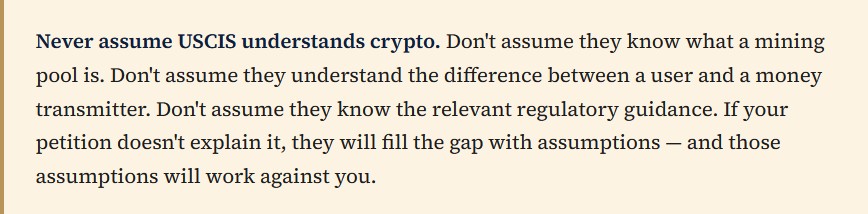
And that burden cannot be met by assuming the reviewing officer understands the crypto ecosystem.
It must be met by explaining — clearly, methodically, and in documented detail — exactly what happened, how the assets were earned, and how they traveled from their point of origin to the investment account.
Three Regulatory Lenses — and Why Each One Matters for Your EB-5 Petition
One of the most consequential — and most frequently overlooked — aspects of crypto-funded EB-5 cases is that your digital asset activity will be evaluated through multiple regulatory frameworks simultaneously.
Each framework asks different questions, applies different standards, and can create different vulnerabilities in your petition.
And those frameworks ask fundamentally different questions. Failing to address each one is a common and costly mistake.
1. The SEC’s View: Was This Investment Activity or Something Else?
USCIS — and the counsel reviewing complex source-of-funds cases — will often look to how the SEC characterizes a petitioner’s crypto activity.
Was it investment? Speculation? Or something categorically different?
For many clients, the answer is: mining.
And mining, in the SEC’s view, is neither an investment contract nor the generation of profits from the efforts of others.
In its March 2025 statement on proof-of-work mining, the SEC’s Division of Corporation Finance was explicit:
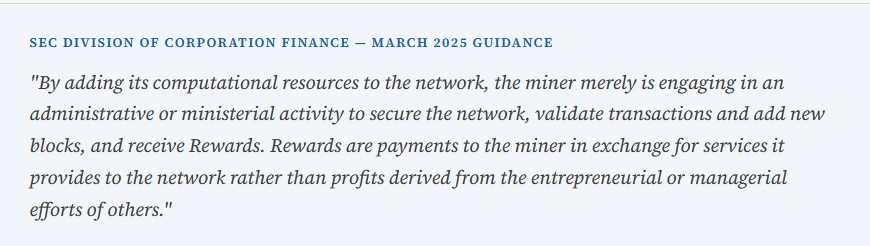
This characterization is critical for EB-5 purposes.
It establishes that Bitcoin earned through mining is compensation for a service — not a return on investment, not a share of pooled profits, and not income derived from others’ work.
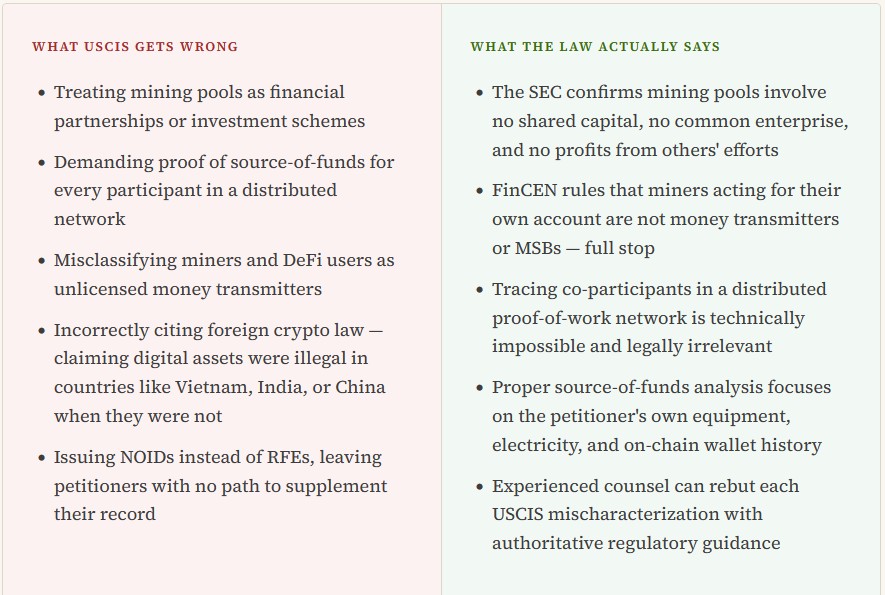
When USCIS attempts to treat a mining pool as a “common enterprise” or “association of miners,” it often follows with a demand to trace the source of funds of every participant.
The SEC’s guidance directly rebuts that framing — and provides the regulatory foundation to push back.
2. FinCEN’s View: Was the Petitioner a Money Transmitter?
This is perhaps the most dangerous mischaracterization USCIS makes — and the one that can most quickly derail a petition.
When reviewing crypto-funded EB-5 cases, USCIS has frequently attempted to classify petitioners’ crypto activity under FinCEN’s money services business (MSB) framework.
The implication is serious: that the petitioner may have operated as an unlicensed money transmitter in violation of the Bank Secrecy Act.
This approach is almost always wrong — and FinCEN said so explicitly, more than a decade ago.
FinCEN’s 2013 interpretive guidance (FIN-2013-G001) established a three-category taxonomy: administrators, exchangers, and users.
Only administrators and exchangers engaged in transmission activity qualify as MSBs subject to registration, KYC, and AML requirements. A user is expressly excluded.
Under FinCEN’s framework, a user is simply a person who obtains virtual currency for their own purposes — a definition that squarely covers the vast majority of individual miners and crypto investors.
FinCEN’s January 2014 administrative ruling (FIN-2014-R001) then went further, addressing Bitcoin mining directly:
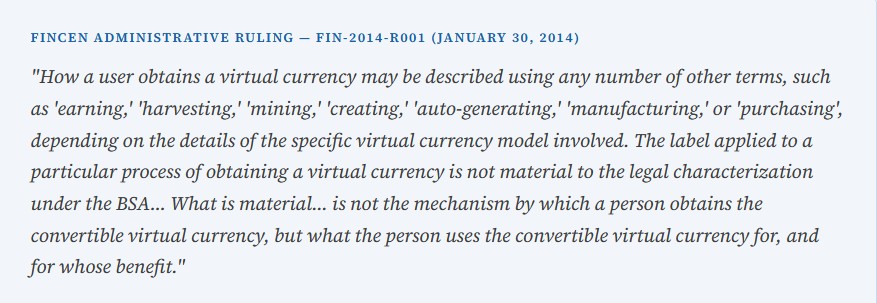
The ruling then provided a definitive conclusion: a person who mines Bitcoin and uses it solely for their own purposes — including converting it to fiat currency or investing it — is not an MSB.
Not subject to FinCEN registration. Not required to implement AML programs. Not required to obtain money transmitter licenses. Not required to maintain KYC records for counterparties.
When USCIS demands proof of BSA compliance, AML programs, or money transmitter licensing from a petitioner who simply mined Bitcoin for their own account — that demand rests on a fundamental regulatory misreading.
Experienced counsel can and must push back on it directly.
3. USCIS’s View: The Chain of Custody Problem
Even when the regulatory classification is correct, the documentation battle is not over.
USCIS will still require a clear, documented, and chronological chain of custody showing how the petitioner’s crypto assets moved from their point of origin to the EB-5 investment.
For petitioners with complex histories — thousands of DeFi transactions, OTC trades, activity on international exchanges, or long-dormant wallets — this reconstruction can be extraordinarily difficult.
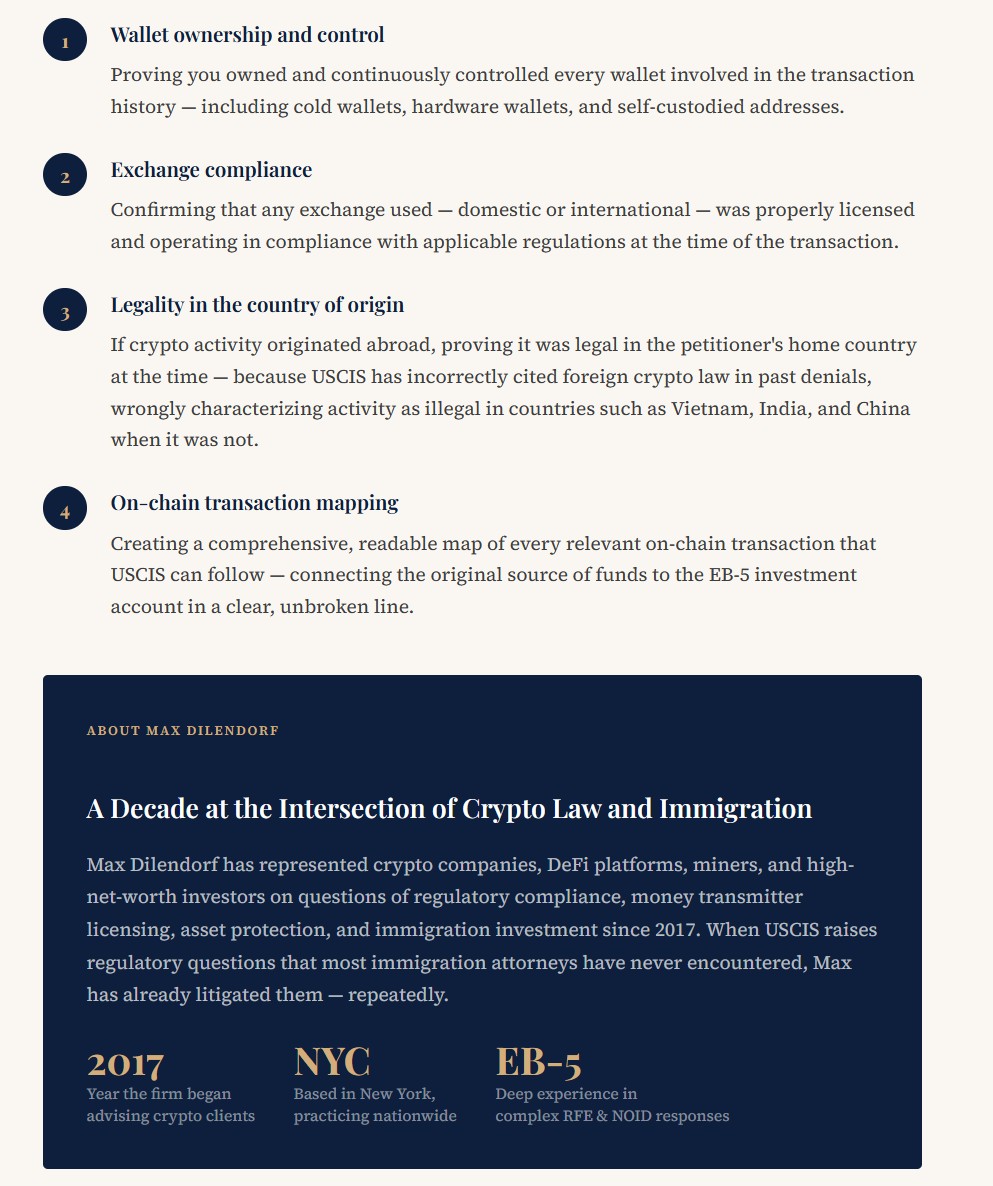
For cases involving DeFi protocols or cross-chain activity, this means documenting:
How Max Dilendorf Solves These Problems
Immigration attorneys regularly refer clients whose EB-5 petitions have been denied — or who have received Requests for Evidence or Notices of Intent to Deny — to Max Dilendorf.
These cases require a skill set that sits at the intersection of crypto regulatory law and immigration, and very few practitioners can offer both.
That intersection is narrow. Very few practitioners operate within it with authority.
Max brings three capabilities to crypto-funded EB-5 cases that most immigration counsel cannot replicate:
Regulatory depth across SEC, FinCEN, and BSA frameworks
Max has represented crypto companies, DeFi platforms, and individual miners on compliance and licensing questions for nearly a decade.
That experience gives him a precise understanding of how regulators view each category of crypto activity — and how to use that knowledge to protect his clients.
That regulatory fluency translates directly into his ability to present a clear, authoritative picture to USCIS adjudicators who may never have encountered these issues before.
When USCIS misapplies FinCEN’s MSB framework to a solo miner, Max can cite the specific ruling that forecloses that characterization.
When USCIS treats a mining pool as a financial partnership, Max can deploy the SEC’s own guidance to demonstrate why that framing is incorrect.
Expert witnesses: former federal cybercrime investigators
Some EB-5 cases involve thousands of DeFi transactions, unusual blockchain histories, or disputed wallet attribution.
In those situations, Max brings in retired federal cybercrime enforcement agents, including former FBI investigators, to support the petition.
These experts serve as expert witnesses, providing authoritative forensic testimony that goes beyond what legal argument alone can establish.
These experts can provide authoritative testimony that the client’s funds were lawfully earned, that wallet control was continuous, and that the blockchain record meets USCIS’s preponderance of evidence standard.
This combination of legal argument and credentialed forensic testimony is often decisive.
Petition-level narrative construction
Source-of-funds documentation is not simply a collection of records — it is a story, and that story must be told in a way that a non-technical adjudicator can follow and believe.
Max guides clients through the I-526 process with this in mind, organizing even the most complex crypto transaction histories into a clear, chronological, and legally grounded narrative.
The goal is to answer USCIS’s questions before they can become denials.
Already Received a NOID or RFE? There May Still Be a Path Forward
If your EB-5 petition has already been met with a Request for Evidence or a Notice of Intent to Deny based on crypto source-of-funds questions, the situation is serious — but it is not always irreversible.
The key is responding with precision, speed, and the right expertise.
A well-constructed RFE response does not simply provide more documentation.
It reframes the regulatory question, demonstrates the legal inapplicability of the demand being made, and presents the petitioner’s complete crypto history in a format designed for the adjudicator’s understanding.
That is work that requires both deep crypto regulatory knowledge and EB-5 procedural experience — and it is exactly what Max Dilendorf’s practice is built for.
The EB-5 process is unforgiving of incomplete preparation. Crypto adds a layer of complexity that most immigration practitioners are not equipped to navigate.
If your wealth is in digital assets and your goal is a U.S. Green Card, the time to get the right counsel is before you file — not after a denial.
Contact Us
If you are considering using cryptocurrency to fund an EB-5 investment, contact Dilendorf Law Firm before you file.
If you have already received a Request for Evidence or Notice of Intent to Deny based on your crypto source of funds, contact us today — time is critical.
Max Dilendorf has represented crypto investors, miners, DeFi participants, and EB-5 petitioners nationwide since 2017.
When USCIS raises questions about digital assets that most immigration attorneys cannot answer, we have the regulatory depth, forensic resources, and courtroom-tested experience to respond effectively.
Do not wait. In crypto-funded EB-5 cases, timing and preparation are everything.
Dilendorf Law Firm, PLLC New York, NY | Representing Clients Nationwide
📞 Call: 212.457.9797 ✉️ Email: info@dilendorf.com
This communication is for informational purposes only and does not constitute legal advice or create an attorney-client relationship. Attorney advertising. Prior results do not guarantee a similar outcome.