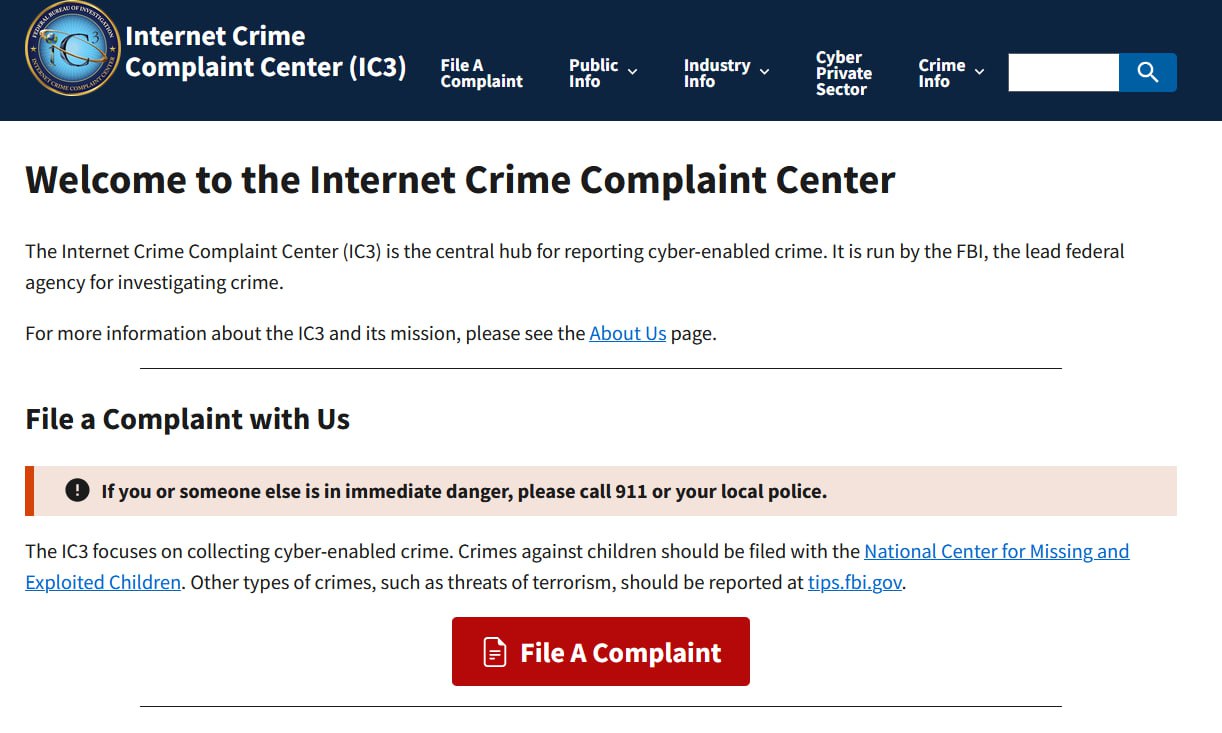
BEWARE IMPERSONATION SCAMS! Be sure that you are interacting with us. We e-mail exclusively from the domain @dilendorf.com PUBLIC NOTICE: We are not affiliated with https://www.dilendorflaw.com. A fraud complaint concerning that website has been filed with the FBI’s Internet Crime Complaint Center (IC3), and the matter is currently under investigation.
If you sent crypto on the wrong network to a U.S. exchange, Dilendorf Law Firm can help. The firm focuses on crypto disputes and arbitration for U.S. customers.
How U.S. exchanges treat wrong‑network deposits
U.S. exchanges try to put all “wrong network” risk on you. Their user agreements and help pages say that unsupported or mis‑sent deposits are your problem, not theirs.
Support teams quote this language when they tell you your funds are “lost” or “irrecoverable.”
Coinbase (U.S.): “not liable” for unsupported assets
Coinbase’s U.S. User Agreement warns that you may use your wallet only for “Supported Digital Assets.”
“Your Digital Asset Wallet is intended solely for proper use of Supported Digital Assets as designated on the Coinbase Site.”
“Under no circumstances should you attempt to use your Digital Asset Wallet to store, send, request, or receive any assets other than Supported Digital Assets. Coinbase assumes no responsibility in connection with any attempt to use your Digital Asset Wallet with Digital Assets that we do not support.”
“You acknowledge and agree that Coinbase is not liable for any unsupported Digital Asset that is sent to a wallet associated with your Coinbase Account.”
If you send crypto over an unsupported network, Coinbase points to this language. It tells users that such assets “may be permanently lost” and that it “cannot recover these assets or funds.”
Coinbase sometimes offers “asset recovery” tools. But those are discretionary. The contract is written so Coinbase can say it does not owe you a duty to recover.
Binance.US: “unable to recover/return” unsupported deposits
Binance.US uses similar wording. Its help center is blunt about wrong‑network deposits.
“Binance.US is unable to recover/return deposits of unsupported assets or deposits sent using unsupported networks.”
It notes that sending to the wrong network “often lead[s] to irrecoverable funds.”
Another page adds: “Binance.US is not liable for any losses if you deposit an unsupported asset, deposit assets using an unsupported network, or transfer an asset to an address not owned by Binance.US.”
Binance.US has a “Deposit Recovery Tool” for some cases. But it excludes unsupported assets and unsupported networks.
Uphold: refusing to retrieve funds on unsupported networks
Uphold takes the same position. In complaints involving wrong‑network transfers, Uphold admits the funds are at a wallet linked to your account but still refuses to act.
“Although the transaction appears on the blockchain at an address associated with your Uphold account, our platform infrastructure does not support access to assets on unsupported networks.”
“While we sympathize with the situation and understand that mistakes can happen, we regret to inform you that we are unable to retrieve or return funds sent via unsupported networks at this time.”
Users report the same outcome. If the asset or network is “unsupported,” Uphold tells them: “we cannot recover them. They’re gone!”
What this means for U.S. victims
The pattern is clear:
Exchanges define what is “supported.” They can change this at any time.
If you send crypto on an unsupported network, they say they are “not liable” and “unable to recover/return” your funds.
They use this language to close your ticket, even when blockchain data shows the funds in an exchange‑controlled wallet.
Many victims stop there. They assume there are no options.
How Dilendorf Law Firm helps
Max Dilendorf and Dilendorf Law Firm focus on exactly these kinds of disputes. The firm has handled more than 130 cybercrime and crypto‑related arbitrations against exchanges and telecom carriers in U.S. forums such as AAA, JAMS, and NAM.
Here is how the firm approaches wrong‑network cases:
Read the contract. The team analyzes the U.S. user agreement, risk disclosures, and arbitration clause that applied to your account and date of loss.
Trace the funds. Using blockchain tools, they show your funds reached an address controlled by the exchange.
Attack one‑sided terms. In arbitration, they argue that boilerplate “not liable” language cannot excuse an exchange when its own design, warnings, or support behavior helped cause the loss.
Run the arbitration. They draft the demand, handle discovery, work with experts, and present your case at the hearing. They have already done this in 130+ cyber and crypto matters.
This is core work for the firm, not a side project.
When to contact Dilendorf Law Firm
Consider contacting Dilendorf Law Firm if:
You are a U.S. customer.
You sent BTC, ETH, USDT, USDC, or another asset to Coinbase, Binance.US, Uphold, or another U.S. platform on the wrong network.
Support pointed you to language like “not liable for any unsupported Digital Asset” or “unable to recover/return deposits of unsupported assets or deposits sent using unsupported networks.”
The firm can review your transaction, explain the terms that exchanges rely on, and outline arbitration or other strategies.
With experience in more than 130 crypto and cybercrime arbitrations, Dilendorf Law Firm is well‑positioned to challenge “lost forever” responses and pursue recovery of wrong‑network deposits
When a victim’s phone is stolen and cryptocurrency is drained from an exchange account, exchanges and telecommunications carriers often argue that the loss was caused solely by third-party criminals.
Dilendorf Law Firm represents victims whose phones were stolen and thieves initiated unauthorized activity from the victims’ cryptocurrency exchange accounts.
The firm handles disputes involving account takeovers, SIM-swap attacks, and rapid unauthorized withdrawals.
Courts do not automatically accept the “third-party criminal” defense.
Courts examine if an exchange’s own security systems, authentication controls, monitoring procedures, or response measures contributed to the loss.
These cases are highly fact-intensive and high risk. Most exchanges require arbitration.
“failing to provide reasonable and appropriate security to prevent unauthorized access to its customer’s account … misrepresenting ‘the safety and security of’ its accounts … failing ‘to adequately safeguard and protect’ the accounts; [and] failing ‘to use readily available security measures to prevent or limit unauthorized access to customer accounts and to prevent unauthorized transactions from occurring on those accounts.’”
The case reflects that exchanges may face liability where internal controls are insufficient to prevent foreseeable unauthorized access.
The court described allegations that Uphold’s implementation of two-factor authentication allowed unauthorized users to access accounts without the original device, thereby compromising account security.
In a stolen-phone case, these allegations are critical.
If authentication can be bypassed without meaningful device verification, biometric confirmation, or withdrawal delays, plaintiffs could argue that the exchange’s security design contributed to the loss.
Negligence and Weakened Safeguards
In Yuille, the court also described allegations that user-experience changes weakened security protections.
The complaint alleged that measures adopted to improve customer service:
“weakened its account security by reducing the situations in which Uphold would restrict [unauthorized] account access.”
Negligence claims often focus on operational failures.
These may include failing to suspend credentials after repeated failed login attempts, failing to delay withdrawals after password resets, or failing to flag large transfers to newly added wallets.
If safeguards are relaxed for convenience, plaintiffs may argue that reasonable care was not exercised.
“…falsely advertised that it provided the best security in the business.”
and that those measures were
“...failed to use standard security measures on its exchange which would have prevented the theft.”
If an exchange promotes “bank-level security” or “advanced fraud monitoring,” yet fails to stop rapid unauthorized withdrawals after a phone theft or SIM-swap attack, those statements may support misrepresentation claims.
Role of Telecommunications Carriers
Stolen-phone and SIM-swap cases often involve telecommunications carriers.
Major carriers such as Verizon, AT&T, and T-Mobile may be implicated where unauthorized SIM swaps or account changes enabled access to exchange accounts.
If a carrier transfers a number without proper identity verification, disables PIN protections, or fails to detect suspicious account activity, plaintiffs may assert negligence or statutory claims against the carrier.
Liability analysis often requires examining both the exchange’s authentication systems and the carrier’s account-security procedures.
Arbitration and High-Risk Litigation
These cases are high risk. Major exchanges, including Coinbase, Binance, Gemini, and Uphold, require arbitration.
They assert assumption-of-risk defenses and argue that possession of login credentials constitutes authorization.
They also argue that third-party criminal acts break the chain of causation.
Carriers raise contractual limitations and federal preemption defenses. Success depends on forensic evidence.
This includes IP logs, device fingerprints, authentication records, internal security policies, SIM-swap documentation, and timing of notice.
Dilendorf Law Firm’s Experience
Dilendorf Law Firm represents victims in stolen-phone and SIM-swap cases involving unauthorized cryptocurrency transfers.
The firm represents clients in disputes against Coinbase, Binance, Gemini, Uphold, and other exchanges.
The firm also represents clients in cases against Verizon, AT&T, T-Mobile, and other telecommunications carriers.
To date, the firm has arbitrated more than 130 cases against crypto exchanges and phone carriers.
These matters involve complex arbitration clauses, evolving regulatory standards, and sophisticated technical evidence.
Stolen-phone cryptocurrency disputes are not routine consumer claims.
They are high-risk, high-stakes proceedings that require experienced arbitration counsel and detailed forensic investigation.
Conclusion
Cases such as Yuille, Rider, Pillar Project, and Widjaja show that exchanges and financial institutions are not automatically insulated from responsibility when unauthorized transfers follow a phone theft.
Plaintiffs may establish liability by demonstrating inadequate safeguards, weakened controls, misleading security representations, or failure to act promptly after notice. Carrier conduct may also be central to the analysis.
At the same time, these cases are complex, arbitration-driven, and high risk.
Careful evaluation of contracts, regulatory obligations, and technical evidence is essential before proceeding.
Contact Us
If your phone was stolen and thieves transferred cryptocurrency or funds out of your exchange account without your authorization, contact Max Dilendorf at Dilendorf Law Firm.
Early action is critical in stolen-phone and unauthorized crypto transfer cases. Prompt investigation can help preserve evidence and assess potential claims against exchanges and telecommunications carriers.
SIM Swap Attacks in 2026: What Victims Need to Know
If you believe you were the victim of a SIM swap attack and lost cryptocurrency or access to your accounts, start with the video above. It explains what likely happened and what legal options may be available.
SIM swap attacks are rapidly increasing in 2026. They are now one of the most damaging forms of cybercrime affecting crypto holders, investors, and everyday consumers.
These attacks often begin when a mobile carrier transfers a customer’s phone number to a SIM card controlled by a criminal.
Once that happens, the attacker receives your calls, text messages, and security codes.
They can reset passwords and access email accounts, crypto exchanges, and self-custody wallets. In many cases, cryptocurrency and other assets are stolen within minutes.
Victims often realize what happened only after their phone stops working.
Many people searching for a SIM swap attorney or SIM swap lawyer are surprised to learn how complex these cases can be.
SIM swap attacks frequently involve failures by wireless carriers such as T-Mobile, Verizon, AT&T, or other providers.
These failures may include weak authentication procedures, ignored security flags, or unauthorized SIM transfers.
When carrier security failures lead to stolen cryptocurrency or financial losses, victims may have legal claims.
These claims are often pursued through arbitration or litigation under federal telecommunications law and consumer protection rules. Timing matters. Evidence can disappear quickly, and deadlines may apply.
In the video above, Max Dilendorf, founder of Dilendorf Law Firm, explains how SIM swap attacks work.
He also discusses why these crimes are accelerating in 2026 and what victims should do immediately after discovering an attack.
Dilendorf Law Firm has handled more than 130 cybercrime and crypto-related matters. These include SIM swap attacks, cryptocurrency theft, software liability disputes, and AI-related fraud.
The firm regularly represents victims in complex arbitration cases against major mobile carriers.
This video is designed to help victims understand their rights. It explains why acting quickly is critical. It also outlines how working with an experienced SIM swap lawyer can help victims evaluate potential recovery options.
Crypto Stolen from Coinbase or Another Exchange? Dilendorf Law Can Help
If your cryptocurrency was stolen from Coinbase or another U.S.-based crypto exchange and the platform denied responsibility, you may still have legal options.
Many victims are told there is nothing an exchange can do—but that is often not the end of the story.
In this video, Max Dilendorf, a New York–based crypto attorney, explains how exchange User Agreements and mandatory arbitration clauses can provide a legal path forward for recovering stolen crypto.
👉 Watch the full video on YouTube:
What This Video Is About
This video focuses on one of the most misunderstood—but most important—documents in crypto disputes: the User Agreement you accepted when opening your exchange account.
Since 2017, Dilendorf Law has worked exclusively in the crypto space.
Since 2019, the firm has been among the first in the U.S. to represent victims of exchange-related crypto theft in arbitration and litigation. To date, the firm has handled 130+ arbitration cases involving stolen customer funds.
In this episode, Max explains:
Why exchanges rely on User Agreements to deny liability
How arbitration clauses often replace lawsuits as the only legal remedy
Why these agreements are legally enforceable—even if you never read them
How missing a notice or procedural step can permanently block your claim
Key Topics Covered in the Video
1. Reviewing the Exchange User Agreement If an exchange refuses to reimburse stolen funds, the User Agreement becomes the legal roadmap for your claim. Max explains how to locate and analyze the dispute resolution and arbitration sections.
2. Understanding Mandatory Arbitration Most U.S. crypto exchanges require disputes to be resolved through private arbitration—not court. The video explains how arbitration works, why it is binding, and what limitations apply.
3. Notice Requirements Before Arbitration Many exchanges require victims to send a formal written notice before filing arbitration. The video explains common deadlines (30–60 days), delivery methods, and why failing to comply can derail a case.
4. Choosing the Arbitration Forum The video breaks down the most common arbitration providers used by crypto exchanges:
American Arbitration Association (AAA)
JAMS
National Arbitration and Mediation (NAM)
Each forum has different rules, fees, and procedures—experience matters.
5. Why Legal Strategy Matters Arbitration decisions are usually final, with limited appeal rights. Max explains why preparation, proper filing, and legal strategy significantly affect outcomes in stolen-crypto cases.
Who Should Watch This Video
This video is especially relevant if:
Your Coinbase or exchange account was hacked
You experienced unauthorized withdrawals or transfers
The exchange denied reimbursement or blamed the user
You’re unsure how arbitration works or where to start
Need Legal Help After Crypto Theft?
If your crypto was stolen and the exchange refused to help, you may still have options—but timing and procedure are critical.
This video is for educational purposes only and does not constitute legal advice. For guidance specific to your situation, consult a qualified crypto attorney.
On December 17, 2025, Coinbase introduced an updated version of its User Agreement.
While many users expected major changes to arbitration and dispute‑resolution rules, those provisions were not amended and continue to govern how hacked‑account and stolen‑funds disputes must be resolved in 2026.
For victims whose crypto was stolen from Coinbase, understanding how these terms allocate risk, limit liability, and channel claims into arbitration is critical to planning an effective recovery strategy.
New Services, Same Arbitration Framework
The update primarily adds and clarifies new services rather than changing the core dispute‑resolution mechanics.
Coinbase introduced a Token Sale Platform that lets users purchase newly issued digital assets directly from third‑party developers, with Coinbase acting only as a platform provider.
The agreement clarifies that U.S. equities trading is conducted through Coinbase Capital Markets Corporation, a registered broker‑dealer affiliate that is legally separate from Coinbase’s digital asset services.
Even with these additions, the mandatory arbitration provisions and class‑action waiver that apply to most crypto‑related disputes remain in place.
Limitation of Liability
The User Agreement continues to impose significant limitations on Coinbase’s liability.
In most circumstances, a user’s potential recovery is capped at the value of the supported digital assets held in the user’s wallet at the time the claim arises.
Users also generally waive the right to recover lost profits, loss of business opportunities, diminution in value, data loss, or other indirect or consequential damages.
Coinbase also provides its services on an “as is” and “as available” basis, disclaims most warranties, and does not guarantee that transactions will be executed accurately or at all.
Liability beyond these limits is permitted only if a court makes a final determination that the harm resulted from Coinbase’s gross negligence, fraud, willful misconduct, or intentional violation of law.
Coinbase’s allocation of responsibility for account security remains unchanged. The User Agreement places responsibility on users for safeguarding login credentials and expressly disclaims liability for losses resulting from compromised credentials, unauthorized access, or misuse of the Trusted Contacts feature.
Coinbase’s Formal Complaint Process remains unchanged
The User Agreement’s Formal Complaint Process remains unchanged.
Under Section 7.2, users must first attempt to resolve any dispute by contacting Coinbase Support.
If the dispute is not resolved through Coinbase Support, users are required to complete Coinbase’s Formal Complaint Process before filing any arbitration claim under Section 7.3.
Failure to complete the Formal Complaint Process may result in dismissal of the arbitration.
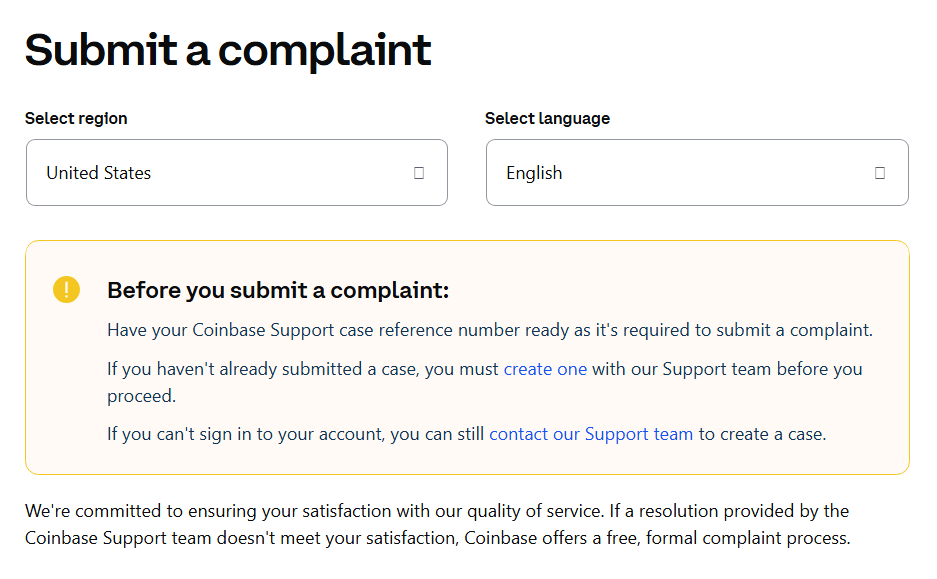
If a dispute proceeds to the Formal Complaint Process, users must submit a complaint using Coinbase’s designated complaint form (or request the form from Coinbase Support), describing the dispute, the requested resolution, and any relevant information.
The Formal Complaint Process is deemed complete when Coinbase responds to the complaint or forty-five (45) business days after Coinbase receives it, whichever occurs first.
Because arbitration cannot be initiated until this process is completed, the Formal Complaint Process serves as a mandatory procedural prerequisite to arbitration under the User Agreement.
For a step-by-step overview of how to comply with Coinbase’s Formal Complaint Process, see:
Arbitration Process Remains Unchanged
The User Agreement’s arbitration provisions also remain unchanged.
Once the Formal Complaint Process is completed, disputes that are not resolved must continue to be pursued through binding arbitration in accordance with the procedures set forth in the User Agreement.
For a detailed, step-by-step overview of how Coinbase arbitration works in practice – including filing requirements, timelines, and procedural considerations – see our previously published guide:
Users should also be aware that the User Agreement continues to include a broad waiver of procedural rights.
Claims against Coinbase must be brought on an individual basis only, and users waive the right to participate in class, collective, or representative actions.
In addition, the User Agreement expressly includes a jury trial waiver, meaning that if any dispute were to proceed in court, it would be resolved by a judge rather than a jury.
The arbitration provisions further permit fee-shifting in limited circumstances. A user may be required to pay Coinbase’s attorneys’ fees and costs if an arbitrator determines that a claim was frivolous or brought for an improper purpose, or if a court finds that the user failed to satisfy required pre-arbitration conditions.
Contact Us
If your Coinbase account was hacked and your crypto was stolen, contact Dilendorf Law Firm to discuss your recovery options and case strategy.
Our team has represented victims in 130+ crypto cyber-theft arbitrations across major forums (AAA, JAMS, NAM), including cases against Coinbase and other leading U.S. exchanges.
The firm focuses on stolen-crypto recovery, SIM-swap and account-takeover cases, and User Agreement–based arbitration claims, integrating blockchain forensics and coordinated law-enforcement engagement where appropriate.
Led by crypto attorney Max Dilendorf (practicing in this space since 2017), the firm represents clients nationwide and internationally in high-stakes exchange disputes.
Email info@dilendorf.com or call (212) 457-9797 to schedule a confidential consultation about your Coinbase theft case.
When a Coinbase exchange account is compromised, victims often feel helpless — the platform is slow to respond, funds disappear quickly, and there’s no way to “reverse” a blockchain transaction.
This guide walks you through every stage — from filing your initial support ticket to submitting a formal complaint and, if needed, pursuing your claim through the next level of dispute resolution.
Can I sue Coinbase in court after my account is hacked?
No. Coinbase’s User Agreement requires disputes to be resolved through binding arbitration, not through state or federal court (with very limited e xceptions).
Appendix 5: Arbitration Agreement “You and we agree to arbitrate all Disputes in binding arbitration except for the following types of Disputes […]”
In other words:
You can’t sue Coinbase in court for most hacking-related claims.
You waive your right to a jury trial.
You can’t join a class action.
Most hacked-account claims must go through AAA (American Arbitration Association) or JAMS.
What should I do first if my account is hacked?
Your first step is to notify Coinbase immediately by filing a support ticket through their help center: help.coinbase.com.
Section 7.1: “If you have feedback, or general questions, contact us via our Customer Support webpage at https://help.coinbase.com.”
This ticket:
Documents the incident.
Creates a case number, which is required for the next stage.
Shows you acted promptly after discovering the hack.
Include as much detail as possible: date and time of the incident, transaction IDs, wallet addresses, suspicious activity, and any phishing or SIM-swap details if applicable.
What is the Formal Complaint process and why is it required?
Before filing any arbitration claim or small claims action, you must complete the Formal Complaint process.
Section 7.2:
“If we cannot resolve the dispute through Coinbase Support, you agree to use the Formal Complaint Process set forth below before filing any arbitration claim or small claims action as described further in Appendix 5 below. You must complete the Formal Complaint Process before filing any arbitration or small claims action. If you do not complete it, then you agree that your claim or action must be dismissed from arbitration or small claims court.”
Section 7.2.1: “In the event that the dispute is not resolved through your contact with Coinbase Support, you agree to use our complaint form to describe your dispute, how you would like us to resolve the complaint, and any other relevant information.”
Include your support case number, a short description of the hack, the amount stolen, the resolution you seek, and any supporting documents.
How long does Coinbase have to respond to my complaint?
Coinbase has 45 business days to respond to your complaint.
Section 7.2.1: “The Formal Complaint Process is completed when Coinbase responds to your complaint or forty-five (45) business days after the date we receive your complaint, whichever occurs first.”
If Coinbase doesn’t resolve the issue after this period, you can proceed to arbitration or small claims court.
What are my options if Coinbase doesn’t resolve my complaint?
If Coinbase doesn’t resolve your dispute within the 45-day complaint period, you have two options:
File a claim in small claims court — but only if your claim meets the court’s jurisdictional limits and remains in small claims court.
Proceed to binding arbitration — which applies to most hacked-account cases.
Appendix 5: “You and we agree to arbitrate all Disputes in binding arbitration except for the following types of Disputes: […] Disputes that are within the jurisdiction of a small claims court. You and we agree that if a Dispute could be brought in a small claims court in the county or parish in which you reside, then it must be brought in that small claims court, not arbitration, provided that it remains in that court and is not removed or appealed to a court of general jurisdiction.”
Most hacking-related disputes involve amounts above small claims limits or become too complex for small claims court, so arbitration is the more common route.
How do I file an arbitration claim against Coinbase?
Once the 45-day complaint period has passed and your issue remains unresolved, the next step is to formally file for arbitration.
It starts with completing the AAA Consumer Arbitration Demand Form through adr.org.
Your arbitration demand must include all applicable claims and adhere to the statute of limitations. Missing critical details or deadlines could weaken or void your case.
Appendix 5: “You and we agree that arbitration under this Arbitration Agreement will, depending on the circumstance, be administered by the American Arbitration Association (‘AAA’) subject to the AAA’s Consumer Arbitration Rules then in effect, except as modified by this Arbitration Agreement. If the AAA is unable or unwilling to administer the arbitration […] you and we agree that JAMS will administer the arbitration.”
This marks the official beginning of the arbitration process. From here, the case moves forward according to the schedule set by the arbitrator.
How much does it cost to file an arbitration claim against Coinbase?
Filing an arbitration claim involves a consumer filing fee, which is typically capped at $225 under the AAA Consumer Arbitration Rules.
Coinbase covers the remaining administrative and arbitrator costs, so customers are only responsible for this initial filing fee. Once your claim is submitted, a neutral arbitrator is appointed, and both parties attend a virtual scheduling conference to set deadlines and outline the next steps in the case.
This process ensures the arbitration remains accessible and cost-effective for individual claimants.
How long does the arbitration process usually take?
Arbitration isn’t resolved overnight. It typically unfolds over several months — often around 9 to 12 months from filing to decision.
Do I need a lawyer to file arbitration against Coinbase?
You’re not required to hire a lawyer, but Coinbase will have legal counsel representing it in arbitration. Having an attorney can make a big difference — they’ll make sure your complaint and arbitration demand meet Coinbase’s procedural requirements, help you gather and organize evidence, and handle all filings and deadlines.
How does Coinbase limit its liability?
Coinbase’s Section 8.2 places strict limits on damages:
“IN NO EVENT SHALL COINBASE […] BE LIABLE (I) FOR ANY AMOUNT GREATER THAN THE VALUE OF THE SUPPORTED DIGITAL ASSETS ASSOCIATED WITH YOUR DIGITAL ASSET WALLET AT THE TIME OF THE EVENT […] OR (II) FOR ANY LOST PROFITS, LOSS OF GOODWILL, LOSS OF DATA, DIMINUTION IN VALUE OR BUSINESS OPPORTUNITY, ANY SPECIAL, INCIDENTAL, INDIRECT, INTANGIBLE, OR CONSEQUENTIAL DAMAGES […]”
This means your recovery is generally capped at the value of the stolen crypto at the time of the hack. Coinbase will also argue it isn’t responsible for “glitches,” “bugs,” or third-party actions. A strong legal strategy anticipates these defenses.
Contact Us
If your crypto was stolen from Coinbase exchange and you’re ready to take action, we can help you file your claim, prepare your evidence, and navigate the arbitration process.
With over six years of experience and a record of handling more than 100 consumer arbitration cases, our firm has pursued claims against major cryptocurrency exchanges as well as leading phone carriers such as Verizon, T-Mobile, and AT&T.
Our attorneys are experienced in navigating proceedings before AAA, JAMS, and NAM, and understand the procedural and strategic nuances that can make or break a case. We also represent victims whose assets were stolen not only from regulated exchanges but also from self-custody wallets like MetaMask and other decentralized platforms.
Reach out to us today to discuss your case and legal options: (212) 457-9797 | info@dilendorf.com.
Attorney Advertising. Prior results do not guarantee a similar outcome. This information is provided for educational purposes and is not legal advice.
If your Binance.US account was compromised, the path to resolution exists. These FAQs explain, step by step, who you’re dealing with, the required pre-filing steps, how arbitration works, what it costs, and how to build a strong, well-documented claim to recover your losses.
Can I sue Binance.US in court after a hack?
No. Under the Terms, customer disputes go to binding arbitration, not court: “Arbitration shall be conducted in accordance with the rules of the American Arbitration Association (‘AAA’), Consumer Arbitration Rules, in effect on the date of the Terms you are currently bound by […] [BAM and You] waive any right to proceed in a court of law or to have their claims heard by a jury.”
Who exactly do I file against?
BAM Trading Services, Inc. (Binance.US)—not Binance.com. Your notices and arbitration are filed against BAM Trading Services, Inc. Using the wrong entity can delay or derail your claim.
What does arbitration look like under the Terms?
Per the Terms: “The arbitration shall: (1) be conducted by a single, neutral arbitrator in the English language; (2) be held virtually and not in person for all proceedings related to the arbitration, except by mutual agreement of all parties; and (3) be limited to one deposition per party, except by mutual agreement of all parties or upon a showing of need.”
For smaller claims: “Furthermore, in cases where neither party’s claim(s) or counterclaim(s) exceed $25,000, both parties agree to waive an arbitration hearing and resolve the dispute solely through submissions of documents to the arbitrator.”
What steps are required before I can file arbitration?
You must complete all pre-arbitration steps in order:
Open a Support Ticket (report the hack).
Submit a Formal Complaint to resolutions@binance.us with a clear description and evidence.
Send a Notice of Dispute to legal@binance.us(account info, claim summary, and what you want).
After Binance.US receives a complete Notice: “Once a complete Notice of Dispute has been received, the recipient has 60 days to investigate the claims […]. An arbitration cannot be filed until the Informal Resolution Period has ended.”
After the 60-day informal period ends, submit the AAA Consumer Arbitration Demand Form online (through adr.org) and pay the consumer filing fee.
How much will this cost me?
The Terms state: “Costs of arbitration, including AAA administrative fees, shall be apportioned between you and BAM in accordance with the AAA Consumer Arbitration Rules.” In practice, the consumer filing fee is capped under the AAA Consumer Rules, and Binance.US covers most administrative/arbitrator fees.
What should I expect after filing?
Arbitration begins when you file your claim with AAA and pay the consumer filing fee. Binance.US must then pay the remaining administrative and arbitrator costs under AAA’s fee schedule.
AAA appoints a neutral arbitrator, and a short online scheduling call will set the deadlines for the case. The process includes limited evidence exchange—usually just one deposition per side—and a hearing if necessary. For smaller claims, the case is often resolved entirely on the written submissions.
Most cases take nine to twelve months from filing to decision.
What evidence should I gather to strengthen my claim?
Arbitrators rely heavily on the documents submitted. A clean and well-organized file can make or break your case. Make sure to collect transaction IDs, timestamps, screenshots of your account activity, login and device logs, any suspicious API key activity, and all emails or messages with Binance.US support.
It’s also smart to file an IC3 report with the FBI and make a police report—these documents add credibility to your claim. Finally, prepare a short timeline that shows when your account was secure, when the theft happened, and what steps you took afterward.
How do I write the arbitration demand?
Your arbitration demand doesn’t need to be written like a legal brief. You’ll need to complete the AAA Consumer Arbitration Demand Form online and submit it through www.adr.org.
A clear, factual statement works best. Include who the parties are, what happened, how much was stolen, and what you’re asking for.
Engaging experienced legal counsel can help you structure a strong, well-supported claim and anticipate the exchange’s defenses. A well-organized demand makes the arbitrator’s job easier — and that often works in your favor.
Can I join a class action instead of arbitration?
No. The Terms include a class-action waiver—you must bring your claim individually in arbitration.
Do I need a lawyer?
Not required, but Binance.US will have counsel. Having a lawyer on your side can help ensure your Notice of Dispute is valid, your AAA demand is airtight, and your evidence is properly organized and presented.
A skilled legal team can also help you minimize your costs, navigate procedural deadlines, and negotiate a stronger settlement if one is offered.
Contact Us
If your crypto was stolen from Binance.US and you’re ready to take action, we can help you file your claim, prepare your evidence, and navigate the arbitration process.
With over six years of experience and a record of handling more than 100 consumer arbitration cases, our firm has pursued claims against major cryptocurrency exchanges as well as leading phone carriers such as Verizon, T-Mobile, and AT&T.
Our attorneys are experienced in navigating proceedings before AAA, JAMS, and NAM, and understand the procedural and strategic nuances that can make or break a case. We also represent victims whose assets were stolen not only from regulated exchanges but also from self-custody wallets like MetaMask and other decentralized platforms.
Reach out to us today to discuss your case and legal options: (212) 457-9797 | info@dilendorf.com.
Attorney Advertising. Prior results do not guarantee a similar outcome. This information is provided for educational purposes and is not legal advice.
When your crypto is stolen from a Binance.US account, the way you respond in the first hours and days can shape your ability to recover funds or bring a legal claim.
Binance.US has a formal process that every user must follow before filing an arbitration claim. Skipping these steps can seriously delay or even block your case.
This guide explains what to do next and how our firm helps clients navigate recovery, law enforcement, and arbitration.
Secure Your Accounts Immediately
If you still have access to your account, act fast:
Change your email and passwords right away.
Switch or reset your 2FA to an authenticator app (avoid SMS).
Take screenshots of balances, withdrawals, login history, IP/device activity, TXIDs, and security settings.
If your phone was SIM-swapped, call your carrier immediately to lock the account and get activity logs.
Why it matters: you’re building the factual record you’ll later use with Binance.US, law enforcement, and in arbitration.
File a Support Ticket with Binance.US
Open a Customer Support ticket. Include TXIDs, timestamps, suspicious IPs/devices, and request log preservation (auth logs, device IDs, IPs, API events).
Binance.US explains that the Support route is the first leg of the complaints path:
“If you have a complaint with BAM, you may, but are not required to, first open a ticket with Customer Support and work with Customer Support to resolve your issue.” Terms of Use
Save the ticket number—you’ll need it for the complaint stage.
File Law-Enforcement Reports
When crypto is stolen, Binance.US will not provide account or transaction records directly to victims — even if it involves your own account. Their Law Enforcement Guide makes clear that such information is only available to U.S. law enforcement and government agencies through formal legal process.
That’s why filing with the right agencies immediately is critical.
Provide Law Enforcement With Binance.US Guidance. Binance.US publishes a Law Enforcement Guide that explains exactly how police or federal agencies should request records.
Why this matters: Binance.US publishes a Law Enforcement Guide describing how U.S. agencies can request records; they respond to valid legal process from law enforcement—not to private requests. Share this link with your detective or agent.
File a Formal Complaint with Binance.US
If Support doesn’t resolve the issue, the next required step is to email resolutions@binance.us.
Your complaint must include:
Your Support ticket number.
A clear description of the problem.
How you’d like Binance.US to resolve it.
Any relevant documentation or evidence.
“Once you have already done so, and Customer Support has been unable to resolve your issue, please email your complaint to resolutions@binance.us […] provide your Customer Support ticket number, state the cause of your complaint, how you would like us to resolve the complaint […] Without a Customer Support ticket, we will not be able to respond meaningfully to your complaint email.”
Binance.US states:
“Within thirty business days […] the Complaint Officer may: (1) offer to resolve your complaint in the way you have requested; (2) reject your complaint and set out the reasons for the rejection; or (3) offer to resolve your complaint with an alternative proposal or solution.”
Important: Without a Support ticket, Binance.US will not process your complaint.
This step creates an official record with their Complaint Officer, which is a required stage before arbitration.
Send a Notice of Dispute (Pre-Arbitration Requirement)
Once you’ve filed a formal complaint and either received a denial or no resolution, the next step required by Binance.US’s Terms of Use is to send a formal “Notice of Dispute.”
This step is not optional — it is a contractual prerequisite to arbitration. If you don’t send this notice correctly, Binance.US can move to dismiss or delay your arbitration claim.
What to Include in the Notice of Dispute
Your email should include:
Your full account details (name, phone, username, email).
A short and clear summary of the issue, including key dates, TXIDs, ticket and complaint numbers.
How you want Binance.US to resolve the claim (e.g., reimbursement, data disclosure, cooperation with law enforcement).
Your lawyer’s contact information, if you have one.
This formal notice isn’t just a formality — it protects your ability to bring a legal claim.
It triggers the 60-day “Informal Resolution Period” during which Binance.US must investigate the claim and can propose settlement.
The statute of limitations is tolled (paused) during this period, preserving your legal rights.
Under the arbitration clause, you cannot file for arbitration until this period ends. If you do, Binance.US can ask the arbitration forum or a court to stop the proceeding.
Your Notice establishes a paper trail showing that you followed the Terms — something arbitrators often look for.
“Once a complete Notice of Dispute has been received, the recipient has 60 days to investigate the claims. If either side requests a settlement conference during this period, then you and us must cooperate to schedule that meeting by phone or videoconference. […] An arbitration cannot be filed until the Informal Resolution Period has ended.”
Move to Arbitration if Binance.US Doesn’t Resolve Your Claim
If your case is not resolved during the 60-day informal resolution period, the only legal path available under Binance.US’s Terms of Use is binding arbitration through the American Arbitration Association (AAA) under the Consumer Arbitration Rules. Arbitration is mandatory for customer disputes, and class actions are not allowed, which means each claim must be pursued individually.
Key Points About the Arbitration Process:
Mandatory under the Terms of Use: Arbitration is required before any legal claim can proceed.
Individual claims only: Class actions are waived, so each case is handled separately.
Virtual proceedings: All hearings are held remotely.
Streamlined for smaller claims: If the claim is under $25,000, the case may be decided on written submissions only, without a live hearing.
Arbitration is a formal legal process, and Binance.US will have experienced defense counsel. A knowledgeable attorney can ensure your claim is filed correctly, backed by strong evidence, and positioned to maximize your recovery.
Understand Exchange Liability
Binance.US, like most major crypto exchanges, disclaims responsibility for losses caused by hacks, phishing, or account takeovers. Unlike banks or traditional brokerages, crypto exchanges are not insured by the FDIC or SIPC — meaning there’s no government protection or automatic reimbursement if your funds are stolen or the platform fails.
This is why following Binance.US’s formal complaint and dispute process is essential. It preserves your legal rights and creates a clear record if the exchange failed to act reasonably or ignored security red flags. While recovery isn’t guaranteed, well-documented claims supported by law enforcement can significantly increase your leverage in negotiations or arbitration.
Contact Us
If your cryptocurrency was stolen from Binance.US due to an account takeover, SIM swap, or any other unauthorized breach, don’t wait to act.
With over six years of experience and a record of handling more than 100 consumer arbitration cases, our firm has pursued claims against major cryptocurrency exchanges as well as leading phone carriers such as Verizon, T-Mobile, and AT&T.
Our attorneys are experienced in navigating proceedings before AAA, JAMS, and NAM, and understand the procedural and strategic nuances that can make or break a case. We also represent victims whose assets were stolen not only from regulated exchanges but also from self-custody wallets like MetaMask and other decentralized platforms.
Time is critical in crypto theft cases. Swift, strategic legal action can make the difference between recovery and permanent loss.
Reach out to us today to discuss your case and legal options: (212) 457-9797 | info@dilendorf.com.
Attorney Advertising. Prior results do not guarantee a similar outcome. This information is provided for educational purposes and is not legal advice.
If your Coinbase account has been hacked, the first step is mandatory. Under Section 7 of Coinbase’s User Agreement, you should begin by contacting Coinbase Support and opening a ticket. This generates a case number, which is essential for the Formal Complaint process.
If the matter is not resolved through Support, the next step is to file a Formal Complaint with Coinbase. Submitting a Formal Complaint starts Coinbase’s 45-business-day response period. Coinbase will acknowledge receipt of your complaint and issue a written resolution notice after review.
Once that resolution notice is sent—or once 45 business days have passed without a resolution—the Formal Complaint process is considered complete. At that point, you may pursue arbitration if necessary.
In short: Support first, Formal Complaint second. This sequence is mandatory for Coinbase clients and is the only way to preserve your right to escalate a dispute with Coinbase.
Step 1 — Notice Begins with Coinbase Support
The first step in giving notice is to contact Coinbase through its Support page. When you open a Support ticket, Coinbase assigns you a case number.
That case number is critical. It shows you gave proper notice and must be included in your Formal Complaint. Without it, your notice will be incomplete.
Step 2 — Notice Continues with the Formal Complaint
If the Support ticket does not resolve the matter, you must escalate by filing a Formal Complaint. This is still part of the required notice process. It tells Coinbase, in writing, that you are formally disputing the unauthorized activity and obligates them to respond.
Coinbase User Agreement, §7.2.1 Procedural Steps: “In the event that the dispute is not resolved through your contact with Coinbase Support, you agree to use our complaint form to describe your dispute, how you would like us to resolve the complaint, and any other relevant information […]. The Formal Complaint Process is completed when Coinbase responds to your complaint or forty-five (45) business days after the date we receive your complaint, whichever occurs first.”
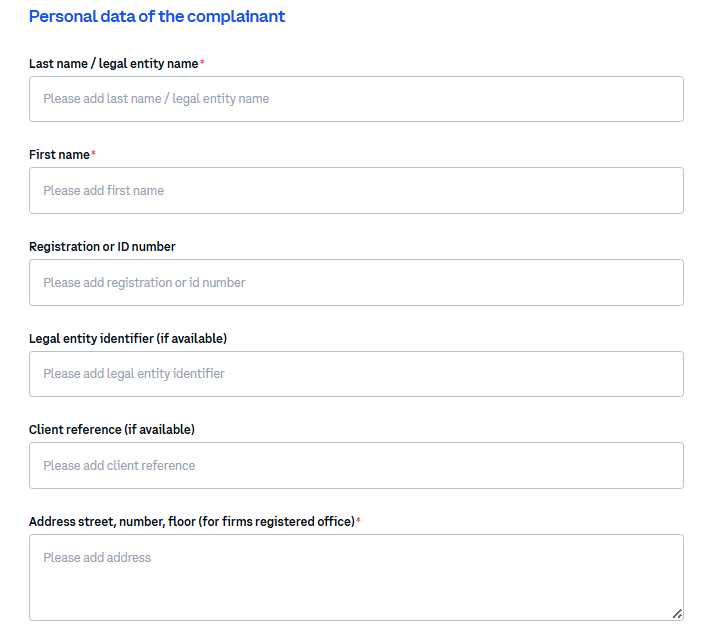
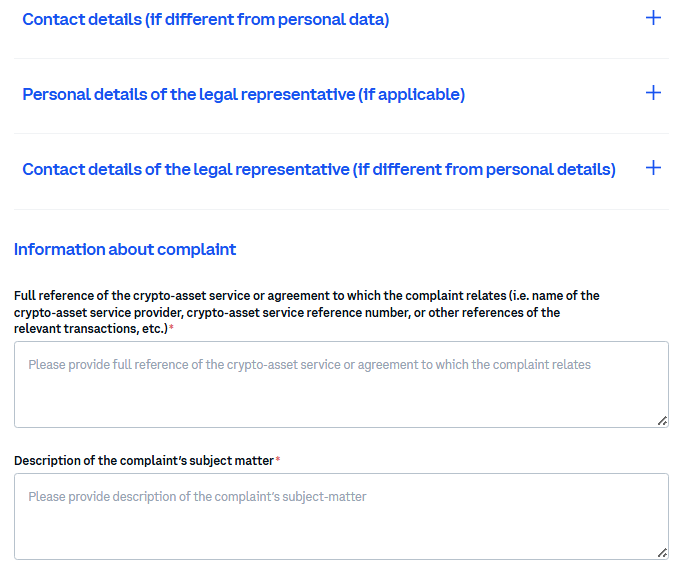
When you submit the complaint online, you will be asked to complete several required blocks, including:
Personal data of the complainant — your name, contact details, and address.
Personal details of the legal representative (if applicable) — if an attorney is filing on your behalf, Coinbase requires a power of attorney or official proof of representation.
Information about the complaint — this is where you must reference your Support case number, describe the unauthorized access, include dates and transaction IDs (TXIDs), and state what resolution you are requesting.
Step 3 — Resolution Notice and 45-Business-Day Timeline
After you submit a Formal Complaint, Coinbase must acknowledge receipt and review it. A Coinbase support representative will then issue a resolution notice.
The complaint process is considered complete when either:
Coinbase sends the resolution notice, or
45 business days pass from the date Coinbase received your complaint.
Only once this process is complete may you pursue arbitration or small claims.
Why Proper Notice Matters
The Coinbase User Agreement makes clear: you cannot skip Support, and you cannot skip the Formal Complaint. Notice is the foundation of your claim. If you fail to provide notice in the exact way required, any arbitration or small-claims action may be dismissed.
“You must complete the Formal Complaint Process before filing any arbitration or small claims action. If you do not complete it, then you agree that your claim or action must be dismissed from arbitration or small claims court.” Coinbase User Agreement, §7.2.
Contact Us
At Dilendorf Law Firm, we focus on helping clients whose digital assets were stolen through hacked exchange accounts, SIM-swapping incidents, or compromised self-custody wallets such as MetaMask.
With over six years of experience and a record of handling more than 100 arbitration cases, we have pursued claims against Coinbase and other leading exchanges, as well as against major phone carriers like Verizon, T-Mobile, and AT&T. Our attorneys are well-versed in proceedings before AAA, JAMS, and NAM, the leading arbitration forums for crypto disputes.
We understand the urgency of these cases and guide clients step-by-step through Coinbase’s notice requirements—from the Support ticket and case number to the Formal Complaint and arbitration.
If your Coinbase account was hacked and your assets were stolen, contact us today to discuss your options for recovery: info@dilendorf.com | (212) 457-9797.
If your crypto was stolen from a U.S. exchange such as Coinbase, Uphold, Binance or Kraken, you might be wondering: What was the exchange supposed to do to protect me?
New York’s BitLicense rules are widely seen as the country’s gold standard for crypto consumer protection. Many large exchanges serve New Yorkers and therefore follow New York’s standards across their whole platform—no matter where you live.
Bottom line: Even if you’re not in New York, you can still point to these expectations when you talk to the exchange or prepare an arbitration claim.
Who This Applies To
The New York Department of Financial Services (NYDFS) says the guidance applies to “all virtual currency business entities that are either licensed under 23 NYCRR Part 200 or chartered as a limited purpose trust company under the New York Banking Law (the ‘VC Entities’).”
If an exchange operates in New York, it’s under this umbrella and is expected to meet these standards. In practice, large exchanges typically use the same controls nationwide, not a weaker version for non-NY customers.
What the Standard of Care Looks Like
1) Detect, Prevent, and Respond to Fraud
NYDFS: “VC Entities are required to implement measures designed to effectively detect, prevent, and respond to fraud, attempted fraud, and similar wrongdoing; and market manipulation is a form of wrongdoing about which VC Entities must be especially vigilant….”
What this means for you: Exchanges should have tools that spot risk early, block or hold suspicious activity, and move fast when something looks wrong (unusual logins, new devices, sudden withdrawals).
These protections should work on both the front end (login/withdrawal security) and the back end (monitoring, alerting, holds).
2) A Real, Written Anti-Fraud Program
NYDFS requires “effective implementation of a written policy that: identifies and assesses the full range of fraud-related and similar risk areas… provides effective procedures and controls… allocates responsibility for monitoring risks; and provides for periodic evaluation and revision….”
What this means for you: There should be a living playbook that covers real threats like phishing, SIM-swaps, device takeovers, and social engineering.
These security features should be paired with concrete protections such as phishing-resistant 2FA, device binding, cooldowns after password resets, withdrawal holds/allow-lists, and on-chain risk screening—with named owners responsible and regular updates as scams evolve.
3) Effective Investigation of Suspected or Actual Wrongdoing
NYDFS: “A VC Entity must provide for the effective investigation of fraud and other wrongdoing, whether suspected or actual….”
What this means for you: When you report theft, the exchange shouldn’t just send boilerplate emails.
It should pull login/IP/device logs, review risk flags, explain why withdrawals were allowed, and document what it did. You’re entitled to ask what steps they actually took.
4) Prompt Reporting to NYDFS and Ongoing Follow-Ups
NYDFS says:
• “Immediately upon the discovery of any wrongdoing, a VC Entity must submit to the Department a report stating all pertinent details….”
• “The Department expects … the first further report … within 48 hours after submission of the original report….”
• “A VC Entity must maintain … records of each incident….”
• “When submitting required reports… use: vcreports@dfs.ny.gov
5) Quick Tips for Victims
• Lock down your accounts immediately: Change passwords (email + exchange), switch to an authenticator app (not SMS), and revoke unknown devices/sessions.
• Call your carrier: Add/confirm a port-out/SIM-swap PIN; ask if there were recent SIM changes.
• Preserve evidence: Save TXIDs, wallet addresses, timestamps, screenshots, emails, chat logs, and create a simple timeline of events.
• File an IC3 report (ic3.gov): Keep the confirmation number with your case file.
• Be cautious with “recovery” offers: Avoid anyone guaranteeing results or demanding big upfront fees.
Conclusion
Arbitrating or litigating a crypto-theft claim is high-risk and difficult. Most exchanges require arbitration and embed terms that shift risk to users, limit remedies, and set strict procedures.
If your funds were stolen, speak with experienced counsel as early as possible to protect your rights and build a strong, fact-driven record.
About Max Dilendorf
Max Dilendorf represents victims nationwide against Coinbase, Kraken, Binance, and Uphold, and SIM-swap victims against T-Mobile, AT&T, and Verizon whose self-custody wallets (e.g., MetaMask) were drained.
With 6+ years in this space, Max has arbitrated crypto disputes across AAA, JAMS, and NAM—handling demand drafting, 100+ crypto-related discovery disputes (motions to compel/protective orders, subpoenas, ESI, privilege), expert coordination, depositions, and taking cases through final evidentiary hearings.
Our website uses cookies. By continuing to use our site, you agree to our use of cookies in accordance with our Privacy Policy.